

A man, to be greatly good, must imagine intensely and comprehensively; he must put himself in the place of another and of many others; the pains and pleasures of his species must become his own.
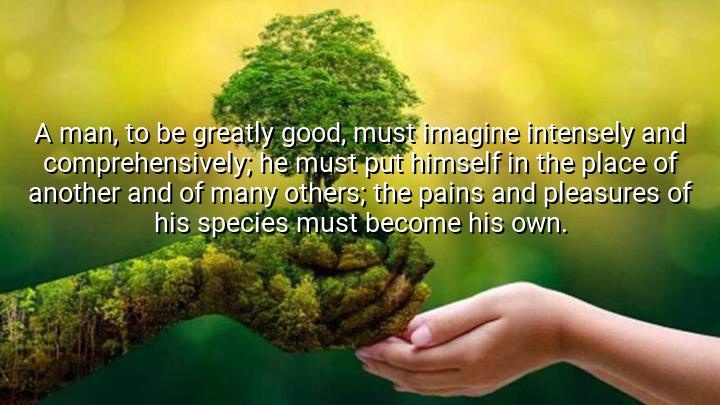




Percy Bysshe Shelley’s quote suggests that true greatness in a person, particularly in terms of moral and ethical character, requires an intense and comprehensive imagination. To be truly good, one must be able to step outside of oneself and understand the pains and pleasures of others, especially those of different walks of life. By putting oneself in the position of others, one can empathize deeply and act with a broader sense of compassion and understanding.
The origin of this quote lies in Shelley’s romantic ideals, where the imagination was seen as the key to both creative and moral greatness. As a poet, Shelley believed that an individual’s imagination should not only fuel creativity but also extend to the moral realm, allowing people to connect with the experiences and emotions of others. He emphasizes that true goodness comes not from self-interest or detached morality but from the ability to feel and understand the struggles and joys of humanity.
Shelley argues that empathy—the ability to deeply feel the suffering and happiness of others—is essential for a person to achieve a truly good life. The idea of experiencing the world from multiple perspectives allows one to act in a way that is not selfish but deeply connected to the broader human experience. This approach to morality is based on the recognition that our actions affect the larger world and that understanding others' struggles and triumphs leads to a more compassionate existence.
In essence, Shelley’s quote highlights the power of imagination as a moral force. By imagining the experiences of others and embracing their pains and pleasures, an individual can transcend personal interests and act in ways that benefit the greater good. This view suggests that greatness lies not in isolated self-interest but in the ability to connect with the collective human experience, making empathy and imagination essential qualities for moral and ethical living.

AAdministratorAdministrator
Welcome, honored guests. Please leave a comment, we will respond soon