

Death is not an event in life: we do not live to experience death. If we take eternity to mean not infinite temporal duration but timelessness, then eternal life belongs to those who live in the present.
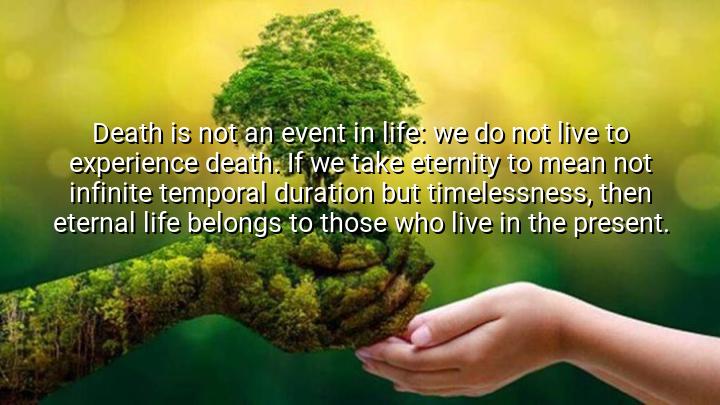




The quote by Ludwig Wittgenstein—“Death is not an event in life: we do not live to experience death. If we take eternity to mean not infinite temporal duration but timelessness, then eternal life belongs to those who live in the present”—is a profound reflection on mortality, time, and the nature of existence. Wittgenstein challenges the common understanding of death as something we can encounter as part of life. Instead, he asserts that since we do not consciously experience our own death, it lies outside the boundaries of life itself.
Wittgenstein, one of the most influential philosophers of the 20th century, wrote this in his early work Tractatus Logico-Philosophicus. This quote emerges from his exploration of language, logic, and metaphysics, particularly the idea that some things—like death and eternity—are beyond the limits of what can be meaningfully discussed. He proposes that true eternal life is not a never-ending stretch of time, but a timeless state accessible only through full presence in the now.
By redefining eternity as timelessness rather than an infinite sequence of moments, Wittgenstein shifts the focus from future expectations to present awareness. His statement that “eternal life belongs to those who live in the present” suggests that spiritual fulfillment and transcendence are available not through the postponement of living, but by embracing the moment fully. This aligns with broader philosophical and even spiritual teachings that emphasize the power of now.
In essence, the quote invites a reconsideration of how we understand life and death. It proposes that rather than fearing death or hoping for an afterlife in the distant future, we should strive for eternal life through deep engagement with the present moment. Wittgenstein’s perspective is both logical and meditative, offering a path to peace not through escape, but through acceptance and presence.

AAdministratorAdministrator
Welcome, honored guests. Please leave a comment, we will respond soon