

Knowledge is in the end based on acknowledgement.
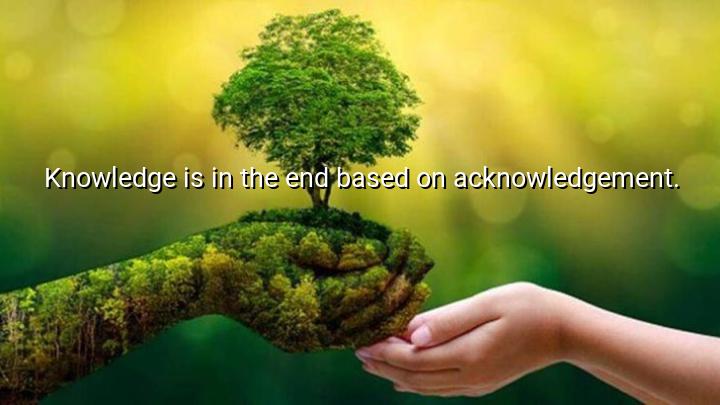




The quote by Ludwig Wittgenstein, “Knowledge is in the end based on acknowledgement,” highlights the foundational role of recognition and acceptance in understanding. Wittgenstein suggests that to truly know something, one must acknowledge its validity and integrate it into one’s awareness. Without this conscious recognition, information remains mere data, not genuine knowledge. In other words, knowledge requires both comprehension and the acceptance of its truth.
This perspective reflects Wittgenstein’s work as a philosopher of language and logic, where he explored how meaning and understanding arise from shared acknowledgement within a community. For him, knowledge is not purely abstract; it is embedded in social and linguistic practices. To claim knowledge is to recognize and affirm a proposition as meaningful and true within the context of a language game or a shared system of understanding.
The origin of this quote lies in Wittgenstein’s later philosophy, particularly in his book Philosophical Investigations, where he challenges the idea of knowledge as a purely individual or isolated phenomenon. He emphasizes that knowledge gains substance and credibility when it is acknowledged by oneself and others, linking the concept of truth to human interaction and practical use.
Ultimately, Wittgenstein’s insight reminds us that knowledge is not just about possessing facts or information; it requires acknowledgement, comprehension, and integration into one’s worldview. This idea encourages a more reflective approach to learning, suggesting that true understanding emerges only when we consciously recognize and engage with the truths we claim to know.

AAdministratorAdministrator
Welcome, honored guests. Please leave a comment, we will respond soon