

Creation destroys as it goes, throws down one tree for the rise of another. But ideal mankind would abolish death, multiply itself million upon million, rear up city upon city, save every parasite alive, until the accumulation of mere existence is swollen to a horror.
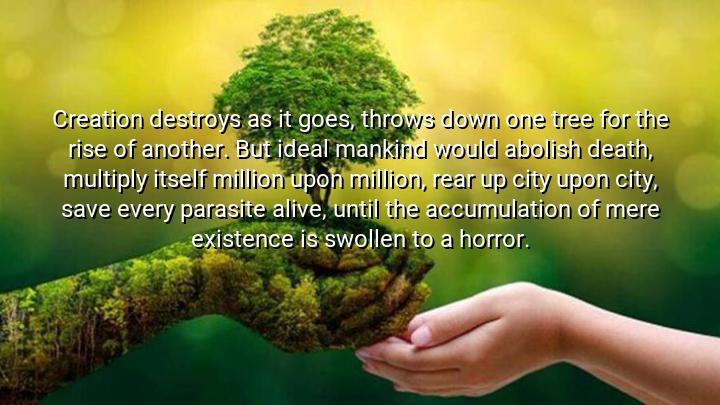




The quote "Creation destroys as it goes, throws down one tree for the rise of another. But ideal mankind would abolish death, multiply itself million upon million, rear up city upon city, save every parasite alive, until the accumulation of mere existence is swollen to a horror." by D. H. Lawrence reflects his critique of human progress and the relentless drive for growth and expansion. Lawrence highlights the natural process of creation and destruction in the world, where new life and systems often come at the cost of others. He contrasts this with a vision of ideal mankind that seeks to eliminate death, increase the population endlessly, and expand cities and industries, which he believes would ultimately result in a horrific and unsustainable accumulation of life and existence.
Lawrence’s view is a commentary on the dangers of unchecked human ambition and the consequences of trying to control or overcome the natural cycles of life and death. While creation involves a balance of destruction and renewal, human efforts to abolish death and continually multiply life would, in Lawrence's view, lead to an unnatural and chaotic state of existence. The "horror" he mentions points to the idea that without the natural end of life and the limits of growth, existence would become overwhelming, with no room for meaning or quality of life.
The origin of this quote stems from Lawrence’s broader exploration of human nature and its relationship to the natural world. Known for his works on the complexities of industrialization, human instincts, and the psychology of individuals and societies, Lawrence often critiqued the modern world and its pursuit of material progress at the expense of spiritual and emotional depth. This quote encapsulates his concern that human desires for eternal life and endless growth could lead to a dehumanizing and unsustainable future.
Ultimately, this quote reflects Lawrence’s belief in the necessity of balance in life, where death and renewal are vital for the health of individuals and societies. His warning against the unchecked pursuit of life and progress is a call for deeper reflection on the natural order and the true meaning of existence. It suggests that in striving for immortality and endless growth, humanity may lose touch with the essence of what makes life meaningful.

AAdministratorAdministrator
Welcome, honored guests. Please leave a comment, we will respond soon