

Change means that what was before wasn't perfect. People want things to be better.
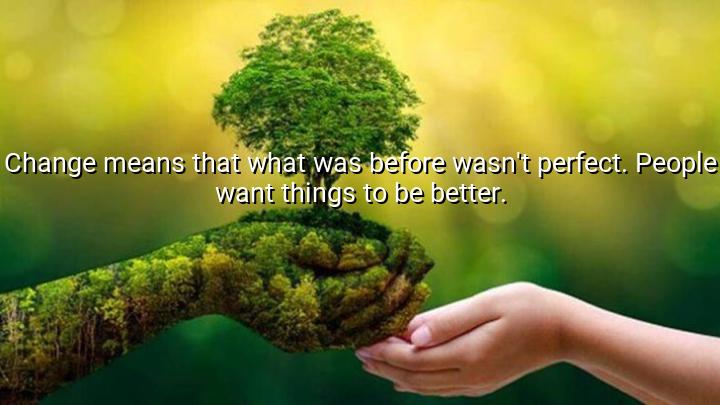




The quote "Change means that what was before wasn't perfect. People want things to be better." is attributed to Esther Dyson, a prominent technology investor, entrepreneur, and commentator known for her work in digital innovation, healthcare reform, and space exploration. As someone deeply involved in shaping the future through emerging technologies, Dyson often speaks about progress, adaptation, and the importance of embracing change. This quote captures her pragmatic and forward-looking perspective on improvement and transformation.
At its core, the quote suggests that change is driven by a desire to correct or improve upon imperfections in existing systems, structures, or ideas. When people advocate for change, it reflects an underlying recognition that the status quo is incomplete, flawed, or outdated. Rather than seeing change as disruptive or negative, Dyson frames it as a natural and necessary response to evolving needs and aspirations.
By stating that “people want things to be better,” Dyson emphasizes the optimistic motive behind most changes. Whether in technology, business, health, or society, individuals and communities seek advancement, aiming for more efficient, fair, or meaningful outcomes. This perspective encourages a solution-oriented mindset, one that views dissatisfaction not as a dead end, but as a powerful catalyst for innovation.
Ultimately, Dyson’s quote serves as a reminder that change is not a rejection of the past, but an acknowledgment that we can do more, and do better. It invites us to see the pursuit of improvement not as a critique, but as a commitment to growth, creativity, and a belief in human potential.

AAdministratorAdministrator
Welcome, honored guests. Please leave a comment, we will respond soon