

Change begins with understanding and understanding begins by identifying oneself with another person: in a word, empathy. The arts enable us to put ourselves in the minds, eyes, ears and hearts of other human beings.
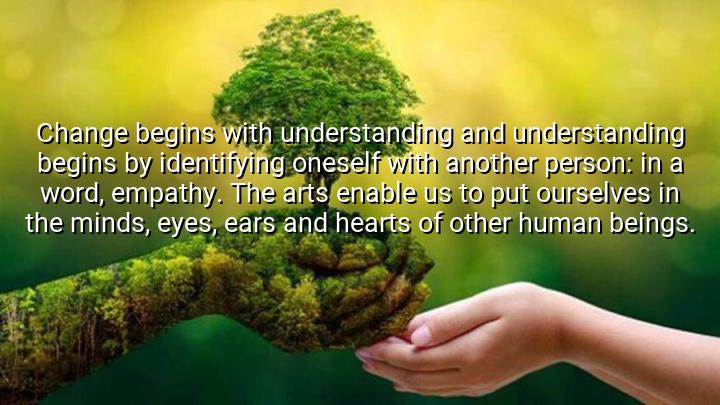




This quote by Richard Eyre, a distinguished British director and advocate for the arts, explores the deep connection between change, understanding, and empathy. Eyre asserts that real change—whether in individuals or societies—begins not with force or argument, but with the ability to understand another person’s experience. At the heart of this process is empathy, the ability to identify with someone else’s emotions, struggles, and perspectives.
By stating that “understanding begins by identifying oneself with another person,” Eyre emphasizes that empathy is the bridge between people. Without it, genuine understanding is shallow or impossible. The quote suggests that only by imagining ourselves in the shoes of others—sharing their feelings, seeing through their eyes—can we begin to form the kind of connections that inspire compassion and ultimately, change.
Eyre then highlights the unique role of the arts in cultivating this sense of empathy. Whether through literature, theater, film, music, or visual art, the arts give us access to the minds, eyes, ears, and hearts of other human beings. Art serves as a window into the experiences of people across time, culture, and circumstance, allowing us to transcend our own limited perspectives and engage with the human condition more fully.
The quote reflects Eyre’s lifelong belief in the transformative power of the arts. As someone deeply involved in storytelling and performance, he understands how art can reshape our emotional intelligence, expand our worldview, and encourage social progress. In a divided world, Eyre’s message is clear: if we want change, we must first learn to feel with others, and the arts are among our most powerful tools for doing just that.

AAdministratorAdministrator
Welcome, honored guests. Please leave a comment, we will respond soon