

Change begets change as much as repetition reinforces repetition.
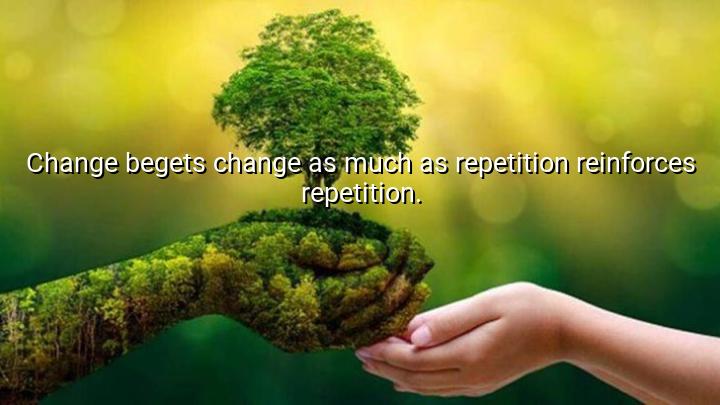




The quote "Change begets change as much as repetition reinforces repetition." is attributed to Bill Drayton, the founder of Ashoka, a pioneering organization that supports social entrepreneurs around the world. Drayton is widely known for popularizing the concept of social entrepreneurship—the idea that individuals can bring about systemic social change through innovative and sustainable solutions. This quote captures a central theme in his philosophy: the powerful, compounding nature of both transformation and habit.
At its core, the quote draws a contrast between two forces: change and repetition. When people or systems take steps toward change, that momentum can lead to further change—creating a cycle of innovation and progress. Conversely, when repetition is allowed to dominate, it can create entrenched patterns that are hard to break. Drayton is emphasizing that both dynamics are self-reinforcing; one can either stay stuck in outdated habits or initiate a ripple effect of growth and evolution.
This idea is especially relevant to Drayton's work with changemakers—individuals who disrupt the status quo to improve communities and institutions. His quote serves as a reminder that once change is initiated, it can become contagious, influencing others and reshaping systems. Likewise, failure to act can result in the entrenchment of inertia, where outdated norms continue simply because they’re familiar.
Ultimately, Bill Drayton’s quote encourages intentional action. It suggests that to foster meaningful transformation—whether in personal life, organizations, or society—we must recognize that change breeds more change, just as routine can breed stagnation. It’s a call to embrace forward movement, knowing that the first step often sets off a much larger chain reaction.

AAdministratorAdministrator
Welcome, honored guests. Please leave a comment, we will respond soon