

By its very nature the beautiful is isolated from everything else. From beauty no road leads to reality.
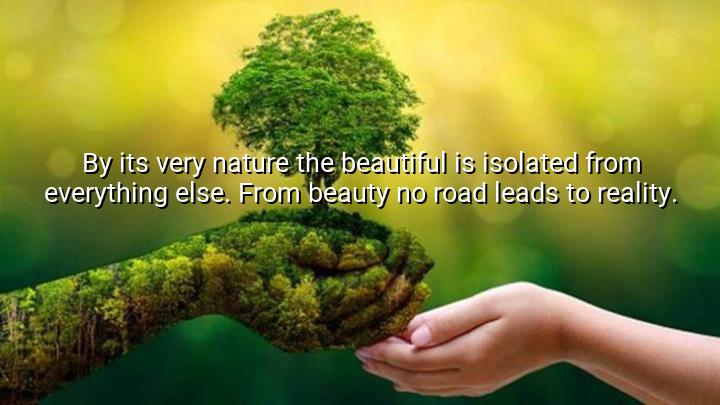




In this quote, Hannah Arendt, a renowned political theorist, reflects on the nature of beauty and its relationship to reality. Arendt suggests that beauty, by its very nature, is isolated from the world around it. This isolation implies that beauty exists in its own realm, detached from the practicalities and complexities of life. It stands apart from the everyday struggles and interactions that define reality, making it an abstract concept that does not easily connect with the world as we experience it.
Arendt’s statement that "from beauty no road leads to reality" implies that beauty is not a direct path to understanding or confronting the world as it truly is. Beauty, whether in art, nature, or human form, has an inherent transcendence that makes it difficult to ground in the harshness of reality. In Arendt’s view, beauty represents an ideal or a form of aesthetic experience that exists separate from the mundane and the practical, leaving no clear bridge to the societal, political, or existential challenges that define human life.
This perspective on beauty also aligns with Arendt’s broader philosophical views on human existence and the relationship between the ideal and the real. Throughout her work, Arendt examined the tension between the realms of thought and action, where beauty, as a pure ideal, stands in contrast to the practicalities of action required to address human suffering, politics, and the realities of the modern world. Beauty, for her, could never serve as a tool for solving these real-world problems because it is too detached from the complexities of human experience.
Arendt’s quote thus invites reflection on how we relate to beauty and its role in our lives. While it can be an enriching and uplifting experience, beauty’s isolation means it cannot be relied upon as a solution or guide for confronting the realities of existence. Her observation challenges us to think about how we engage with beauty and whether we are using it to escape or to enhance our understanding of the world around us.

AAdministratorAdministrator
Welcome, honored guests. Please leave a comment, we will respond soon