

But who can paint like Nature? Can imagination boast, amid its gay creation, hues like hers?
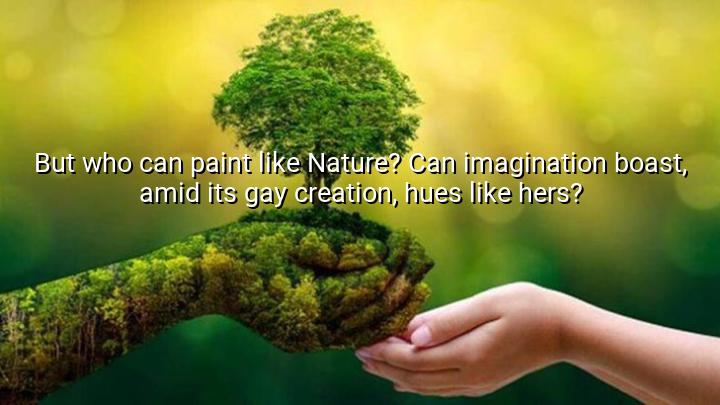




The quote "But who can paint like Nature? Can imagination boast, amid its gay creation, hues like hers?" by James Thomson reflects on the incomparable beauty and complexity of nature compared to human creative efforts. Thomson, a Scottish poet best known for his poem The Seasons, emphasizes that no matter how vivid or colorful human imagination may be, it cannot replicate the intricacies and richness found in the natural world. The reference to "painting" symbolizes artistic creation, and Thomson is suggesting that nature's palette of colors, textures, and forms far surpasses anything that can be conceived by the human mind.
Thomson's statement highlights the idea that imagination, while powerful and capable of creating beautiful and intricate works of art, cannot truly capture the full depth and beauty of nature. Nature, with its infinite variety, remains the ultimate source of inspiration, and no matter how skilled the artist, there is always something that is beyond the scope of human creativity. By comparing imagination to nature, Thomson acknowledges the limitations of art in fully mirroring the natural world.
The origin of this quote is tied to Thomson’s broader reflections on the relationship between human creativity and the natural world. In The Seasons, he celebrates the beauty and power of nature, often contrasting it with human endeavors. His works are infused with a sense of awe toward nature’s complexity and divine design, emphasizing how it can evoke feelings of wonder and reverence that are unmatched by human creations.
Ultimately, Thomson’s quote is a meditation on the humility of human creativity in the face of the natural world. While imagination can give birth to wonderful works of art, it is ultimately nature that provides the most breathtaking beauty. The quote serves as a reminder that nature is the ultimate artist, and our creative efforts, though valuable, can never fully replicate the majesty of the world around us.

AAdministratorAdministrator
Welcome, honored guests. Please leave a comment, we will respond soon