

I know no subject more elevating, more amazing, more ready to the poetical enthusiasm, the philosophical reflection, and the moral sentiment than the works of nature. Where can we meet such variety, such beauty, such magnificence?
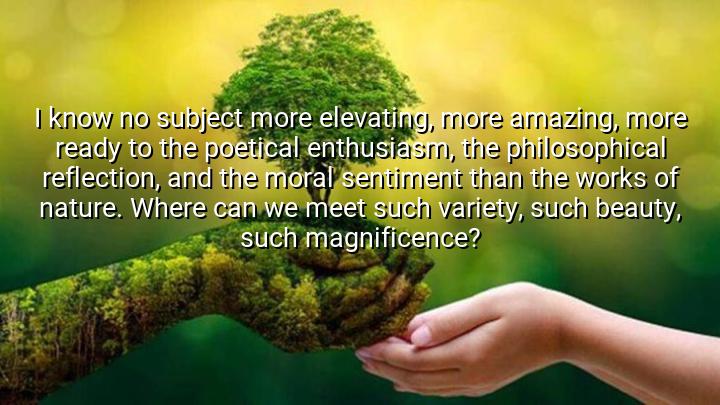




The quote "I know no subject more elevating, more amazing, more ready to the poetical enthusiasm, the philosophical reflection, and the moral sentiment than the works of nature. Where can we meet such variety, such beauty, such magnificence?" comes from James Thomson, an 18th-century poet best known for his work "The Seasons". This statement reflects Thomson’s deep admiration for the natural world and its ability to inspire a range of human responses. He emphasizes how nature can evoke poetical enthusiasm, philosophical reflection, and moral sentiment, suggesting that it serves as a boundless source of creativity and insight.
Thomson’s works, particularly "The Seasons", explore the changing landscapes and elements of nature, illustrating their influence on human emotions, thought, and morality. By describing nature as "elevating" and "amazing," he underlines its power to uplift the human spirit and provoke deep contemplation. The quote speaks to how nature’s variety, beauty, and magnificence provide endless opportunities for artistic and intellectual exploration, inviting people to engage with it in a deeply personal way.
The use of terms like "poetical enthusiasm" and "philosophical reflection" highlights the dual nature of nature’s impact—it stirs both creative and intellectual energies. For Thomson, nature is not just a passive backdrop, but an active, vibrant force capable of enriching the human experience. His statement urges us to recognize the profound influence that nature has on art, thought, and personal growth, positioning it as the ultimate muse for all forms of human expression.
In summary, Thomson’s quote conveys his belief in the transcendent power of nature. It suggests that, through nature, we encounter not only physical beauty but also the potential for philosophical insight and moral growth, making it one of the richest and most inspiring subjects available to humanity.

NNNhi Ngoc
Thomson’s words are beautiful, but I can’t help but think about how environmental degradation might impact this kind of admiration. Can we still see nature as ‘magnificent’ when so much of it is under threat? How do we reconcile the poetic ideal of nature with the reality of climate change and ecological loss? It’s a tension that adds urgency to his reflections.
NDNgoc DuongKhanh
This quote makes me curious—do poets and philosophers today still hold nature in the same regard, or has the focus shifted to more human-centric themes like identity, technology, or society? Thomson seems to suggest nature is the ultimate muse, but in our current world, is that view still relevant or increasingly nostalgic? I’d love to explore some contemporary responses to nature in art and literature.
BBao
I find myself agreeing with this sentiment, especially when I think about how calming and perspective-shifting a simple walk in the forest can be. But I also wonder, can the modern urban world offer its own kind of beauty, or is Thomson’s admiration exclusive to untouched landscapes? Is the ‘variety and magnificence’ he speaks of lost in human-built environments, or can we learn to see it differently?
DHDao Huynh
James Thomson’s passion for nature is inspiring, and it makes me wonder: what specific experiences might have shaped this reverence in him? Did he grow up surrounded by wilderness or travel extensively through scenic places? It would be fascinating to explore what personal encounters he had with nature that led him to elevate it above all other subjects so emphatically.
NNNhung Nguyen
This quote really resonates with me—there’s something undeniably transcendent about nature. I wonder, though, whether modern life has dulled our capacity to see it the way Thomson describes. With screens and distractions everywhere, do people still pause to reflect poetically or philosophically in natural settings? Or has that sense of awe become rare? I’d love to hear how others reconnect with nature in their daily lives.