

But man is not made for defeat. A man can be destroyed but not defeated.
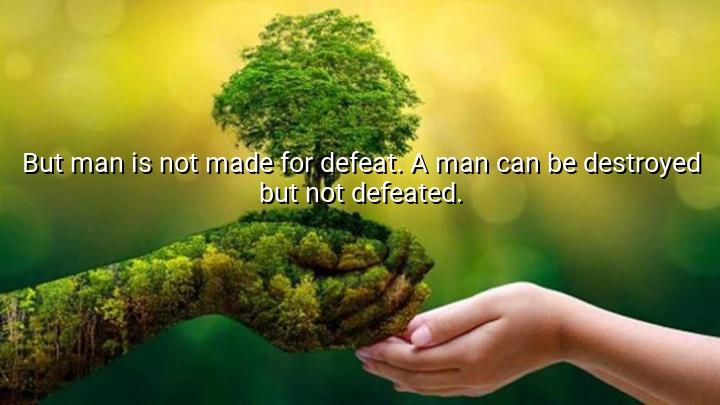




The quote by Ernest Hemingway, "But man is not made for defeat. A man can be destroyed but not defeated," emphasizes the resilience of the human spirit. Hemingway suggests that while a person may face challenges and hardships that threaten to destroy them physically or emotionally, they cannot be defeated as long as they continue to hold onto their inner strength. The quote reflects the idea that true defeat occurs not when we fall, but when we allow ourselves to give up or lose hope.
Hemingway's words point to the difference between being broken and being truly defeated. Being destroyed implies that a person may be damaged or hurt, but as long as they retain the will to continue, they are not defeated. This idea emphasizes the importance of perseverance and the refusal to surrender, even when faced with seemingly insurmountable obstacles. The notion that man is not made for defeat speaks to the inherent strength and dignity of human resilience.
The origin of this quote is tied to Hemingway’s work, particularly his novel The Old Man and the Sea. In the story, the protagonist, Santiago, faces a long and grueling battle with a giant marlin. Throughout the struggle, Santiago endures great physical and emotional suffering, yet he never allows himself to be defeated by the sea or the fish. This battle embodies Hemingway’s belief in the indomitable nature of the human spirit, where even in the face of failure or destruction, one's resolve can remain unshaken.
In essence, Hemingway’s quote reminds us that defeat is not defined by external circumstances, but by our inner response to adversity. It encourages us to rise above the challenges and remain true to our sense of purpose and strength, no matter how many times we are knocked down. Through perseverance and resilience, we can withstand the most difficult trials without ever truly being defeated.

AAdministratorAdministrator
Welcome, honored guests. Please leave a comment, we will respond soon