

Brands who come to China, often they just care about price - so they actually drive the suppliers to cut corners on environmental standards to win a contract.
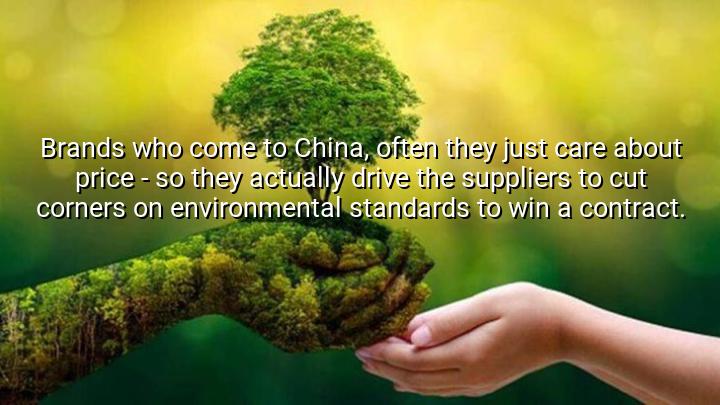




In this quote, Ma Jun highlights a critical issue in the relationship between brands and suppliers in China. He suggests that many companies, when entering the Chinese market, are overly focused on price and profit margins. This intense pressure to reduce costs can lead them to push suppliers to cut corners on environmental standards in order to secure a contract. As a result, the pursuit of cheaper production often comes at the expense of environmental protection, leading to unsustainable practices and pollution.
Ma Jun is emphasizing the negative impact of cost-cutting in the supply chain, particularly in countries like China, where rapid economic growth has sometimes led to a disregard for environmental regulations. By focusing solely on low prices, these companies contribute to the compromise of long-term environmental sustainability. Ma Jun’s statement calls attention to how market dynamics can incentivize irresponsible practices that harm the environment, despite the potential for businesses to prioritize both affordability and environmental responsibility.
The origin of this quote comes from Ma Jun, a well-known Chinese environmentalist and founder of the Institute of Public and Environmental Affairs (IPE). Ma Jun has been a leading advocate for environmental protection in China, especially in terms of air and water pollution. His work often focuses on holding corporations accountable for their environmental impact, particularly in light of China’s rapid industrialization. Ma Jun’s critique of foreign brands highlights the complexities of operating in a developing economy where economic incentives sometimes overshadow environmental concerns.
Ultimately, Ma Jun’s quote is a call to action for brands to adopt more sustainable practices and not sacrifice environmental standards for short-term profits. He advocates for a shift in how companies engage with their suppliers and markets, emphasizing the need for a balance between affordable production and environmental responsibility. This reflects his broader belief that businesses can and should be part of the solution to environmental challenges, rather than contributing to their worsening.

AAdministratorAdministrator
Welcome, honored guests. Please leave a comment, we will respond soon