

If major companies sourcing in developing countries care only about price and quality, local suppliers will be lured to cut corners on environmental standards to win contracts.
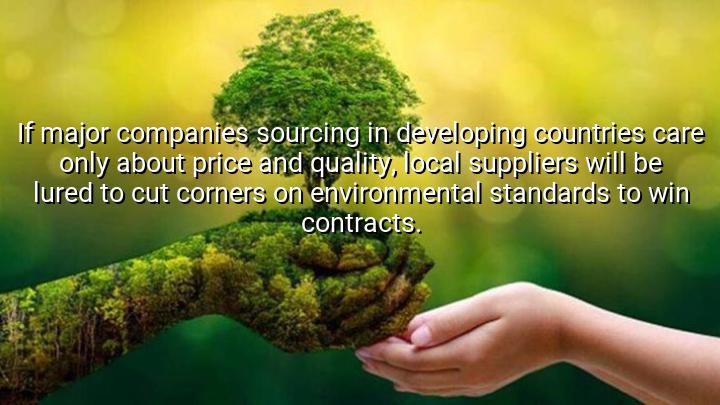




In this quote, Ma Jun warns about the potential consequences when major companies prioritize price and quality over environmental considerations when sourcing products from developing countries. He suggests that if businesses only focus on these two factors, they may inadvertently create an incentive for local suppliers to cut corners on environmental standards in order to secure contracts. This could lead to a race to the bottom, where the pursuit of cheaper costs compromises the sustainability and ethical practices that are needed in global supply chains.
The underlying concern is that when environmental standards are not part of the competitive equation, suppliers may disregard them to offer the lowest possible price. This is particularly prevalent in developing countries, where businesses may be more vulnerable to the pressures of cost-cutting due to limited resources or weaker regulations. The quote highlights a vicious cycle where cost-efficiency overshadows long-term environmental responsibility.
Ma Jun’s perspective emphasizes the ethical dilemma facing companies and suppliers in global supply chains. While price and quality are critical to business success, they cannot come at the expense of environmental sustainability. By ignoring the environmental impact, companies may be fostering harmful practices that degrade both the environment and local communities.
This statement underscores the importance of corporate responsibility and the need for businesses to take a holistic view of their sourcing practices. The quote encourages companies to value sustainability and ensure that their operations promote ethical practices across all levels of production, not just cost-efficiency.

AAdministratorAdministrator
Welcome, honored guests. Please leave a comment, we will respond soon