

'Beauty is truth, truth beauty,' - that is all ye know on earth, and all ye need to know.
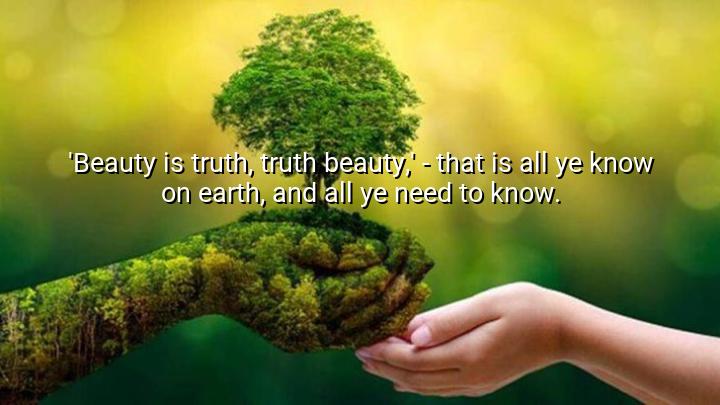




In the quote by John Keats, "'Beauty is truth, truth beauty,' - that is all ye know on earth, and all ye need to know," Keats presents a profound, philosophical connection between the concepts of beauty and truth. He suggests that the two are inseparable, with each reflecting and embodying the other. For Keats, the pursuit of beauty—whether in nature, art, or human experience—can lead to a deeper understanding of truth, while truth itself holds an inherent beauty. This perspective implies that beauty and truth are not separate, abstract ideas, but two aspects of the same profound reality.
The origin of this quote is found in Keats' famous poem, Ode on a Grecian Urn, where the phrase is used to conclude the poem. In this context, the urn, which depicts frozen moments of beauty, becomes a symbol of eternal truth. Keats' poetic exploration of the relationship between art, beauty, and truth is central to his work, particularly within the Romantic movement, which sought to elevate the aesthetic and emotional experiences of life as ways of understanding deeper truths about the human condition and the natural world.
Keats' statement, "that is all ye know on earth, and all ye need to know," reflects a sense of finality and completeness. By asserting that the connection between beauty and truth is the ultimate knowledge that humans need, he implies that both qualities are central to understanding existence. In this view, beauty is not merely superficial or decorative; it is a deeper, essential truth that transcends intellectual understanding and resonates on a more intuitive, emotional level.
Ultimately, this quote encapsulates Keats' belief in the transformative power of beauty and its ability to reveal truth. It suggests that rather than seeking truth through logic or reason alone, one can find it through an appreciation of beauty in art, nature, and life. Keats elevates the role of aesthetic experiences, claiming that they offer insights into the deepest realities of the human experience.

AAdministratorAdministrator
Welcome, honored guests. Please leave a comment, we will respond soon