

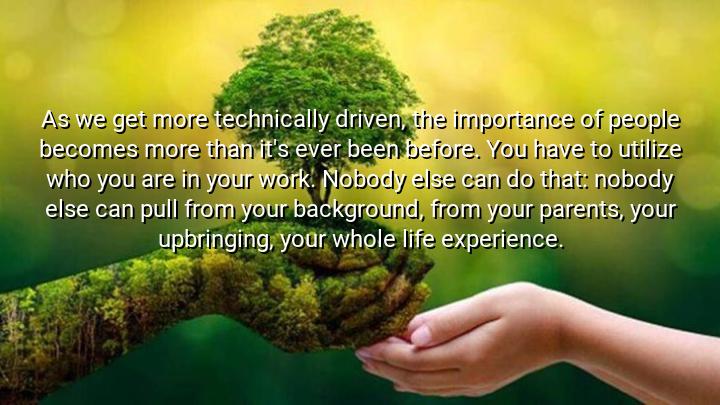
As we get more technically driven, the importance of people becomes more than it's ever been before. You have to utilize who you are in your work. Nobody else can do that: nobody else can pull from your background, from your parents, your upbringing, your whole life experience.
As we get more technically driven,
As we get more technically driven, the importance of people becomes more than it's ever been before. You have to utilize who you are in your work. Nobody else can do that: nobody else can pull from your background, from your parents, your upbringing, your whole life experience.

As we get more technically driven,
As we get more technically driven, the importance of people becomes more than it's ever been before. You have to utilize who you are in your work. Nobody else can do that: nobody else can pull from your background, from your parents, your upbringing, your whole life experience.
As we get more technically driven,
As we get more technically driven, the importance of people becomes more than it's ever been before. You have to utilize who you are in your work. Nobody else can do that: nobody else can pull from your background, from your parents, your upbringing, your whole life experience.
As we get more technically driven,
As we get more technically driven, the importance of people becomes more than it's ever been before. You have to utilize who you are in your work. Nobody else can do that: nobody else can pull from your background, from your parents, your upbringing, your whole life experience.
As we get more technically driven,
As we get more technically driven, the importance of people becomes more than it's ever been before. You have to utilize who you are in your work. Nobody else can do that: nobody else can pull from your background, from your parents, your upbringing, your whole life experience.
As we get more technically driven,

The quote by Joyce Meyer, "There are some hurts that we experience that can be forgiven but we won't forget them," explores the complex relationship between forgiveness and memory. Meyer acknowledges that while forgiveness is a powerful and necessary step for healing, it doesn’t always mean that the painful experiences or hurts we endured are erased from our memories. This highlights the idea that forgiveness is about releasing resentment and finding peace, but it doesn’t require forgetting the lessons learned or the impact those experiences had on us.

The origin of this quote comes from Meyer’s work as a Christian author and speaker who often discusses themes of emotional healing and spiritual growth. Her perspective is rooted in the belief that forgiveness is essential for personal freedom, but it also respects the reality that some wounds leave lasting impressions. Meyer’s statement encourages a balanced view of forgiveness—one that frees the heart without denying the significance of past pain.

This quote also emphasizes the importance of acknowledging and remembering our experiences while choosing to let go of bitterness. By not forgetting the hurt, we maintain awareness and caution that can protect us in the future. Yet, forgiveness allows us to move forward without being trapped by anger or revenge.

In summary, Joyce Meyer’s quote teaches that forgiveness and memory can coexist. It reminds us that forgiving does not mean forgetting, but rather finding a way to heal while honoring the reality of our past experiences.

David Carson
David Carson

American - Designer Born: September 8, 1954

Have 0 Comment As we get more technically driven,

AAdministratorAdministrator

Welcome, honored guests. Please leave a comment, we will respond soon

Reply.
Information sender
Leave the question
Click here to rate
Information sender
0.43024 sec| 2552.703 kb