

As a science fiction fan, I had always assumed that when computers supplemented our intelligence, it would be because we outsourced some of our memory to them. We would ask questions, and our machines would give oracular - or supremely practical - replies.
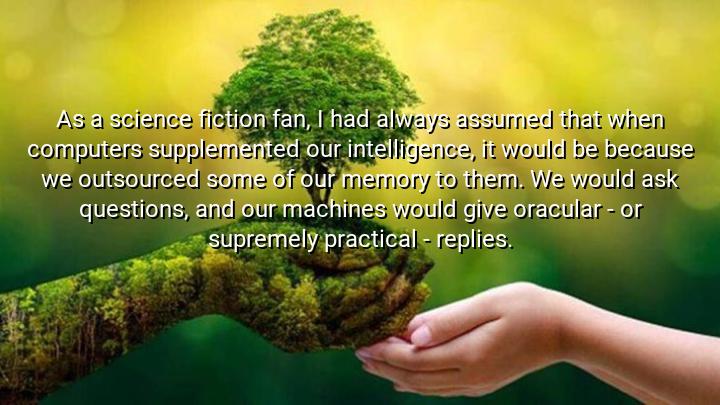




In this quote, Gary Wolf reflects on his expectations as a science fiction fan regarding the future relationship between humans and computers. He imagined that as computers became more integrated into our lives, they would enhance human intelligence by taking on some of our memory functions. Wolf envisioned a world where humans would outsource their cognitive load to machines, allowing them to ask questions and receive practical or even oracular responses. This expectation draws from many science fiction narratives that portray computers as entities capable of providing vast, almost mystical knowledge.
Wolf's idea highlights the optimistic belief that technology would one day help us extend our memory and decision-making abilities, functioning almost as external minds. The concept of oracular replies suggests a belief that machines would not only offer answers but would do so in an almost prophetic or wise manner, aligning with the way computers were imagined in early science fiction stories. His use of "oracular" contrasts the mystical nature of human prediction with the practical and functional support that computers could provide.
The quote also shows how science fiction shaped the public's understanding of future technology. Wolf's earlier assumption reflects the traditional view that computers would act as assistants that could simply recall and present information, enhancing our capabilities. However, as computers evolved, they have become more complex, performing a variety of tasks beyond just memory retrieval, including analysis, automation, and artificial intelligence.
Ultimately, Wolf’s reflection reveals the gap between the idealized vision of computers in science fiction and their actual evolution. While we do rely on machines to enhance and store information, modern technology has expanded beyond simple memory assistance, evolving into tools that transform our understanding, creativity, and interactions in ways that were unimaginable in earlier science fiction visions.

AAdministratorAdministrator
Welcome, honored guests. Please leave a comment, we will respond soon