

Although believers by nature, are far from God, and children of wrath, even as others, yet it is amazing to think how nigh they are brought to him again by the blood of Jesus Christ.
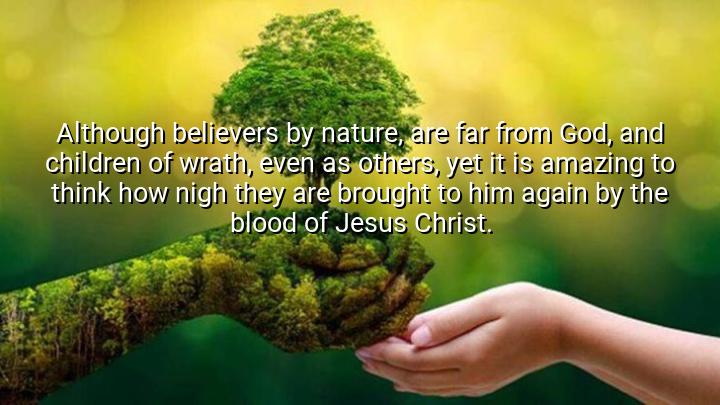




The quote "Although believers by nature, are far from God, and children of wrath, even as others, yet it is amazing to think how nigh they are brought to him again by the blood of Jesus Christ." comes from George Whitefield, an influential English preacher and one of the key figures in the Great Awakening. This statement reflects his deep Christian faith and belief in the power of Jesus Christ's sacrifice to reconcile humanity with God. Whitefield acknowledges the inherent distance between humanity and God, a distance caused by sin, yet he marvels at how through Christ's sacrifice—symbolized by His blood—believers can be brought near to God again.
The phrase "children of wrath" refers to the idea that, by nature, all humans are separated from God due to sin, as expressed in various parts of Christian scripture. Whitefield’s use of this term emphasizes the human condition before receiving Christ's redemptive grace. Despite this inherent separation, he emphasizes how believers, through their faith in Jesus, are restored and made close to God once more.
Whitefield’s focus on the blood of Jesus Christ highlights the central Christian doctrine of atonement, where Christ’s death on the cross is seen as the ultimate act that bridges the gap between humanity and God. By this act, believers are forgiven, and their relationship with God is restored. This idea underscores the amazing and transformative nature of Christian salvation—a gift that brings believers near to God despite their sinful nature.
In summary, this quote encapsulates Whitefield's reverence for Christ’s atonement and the miraculous nature of salvation in Christianity. It reflects the profound spiritual significance of Jesus’s sacrifice, offering a pathway for believers to be reconciled with God and experience divine closeness despite their inherent separation from Him.

NNgocphuong
Whitefield’s words are powerful, but they also reflect a very specific theological worldview. I wonder how inclusive this view is to people of different faiths or those who seek God through other paths. Is this kind of exclusivity part of what defines traditional evangelical belief, or is there room in Christian thought for more pluralistic understandings of nearness to God?
KCNong Thi Kim Cuc
As someone exploring spirituality, this quote raises a curious tension for me. If believers are still 'by nature' far from God, what differentiates them from non-believers before grace intervenes? Is belief alone enough to close that gap, or is there more to it—like transformation of character or behavior? It makes me wonder how salvation is truly measured or understood.
PVNguyen Phuong Vy
What strikes me most is the emphasis on Christ’s blood as the means of reconciliation. It makes me think about how central the concept of sacrifice is in Christian belief. Why is such a dramatic, even violent, symbol considered the pathway to peace and nearness to God? I’d love to hear perspectives on how this imagery is received by believers and non-believers alike.
CALe Duc Chi Anh
There’s a lot of humility in this quote, especially in acknowledging how far we start from divine grace. But I wonder—does framing believers as naturally distant from God discourage people from seeing their own worth? Or is the idea meant to magnify the power of redemption? I think there’s a fine line between acknowledging imperfection and fostering spiritual guilt.
HNNguyen Hai Nguyen
I find the emotional intensity of this quote compelling. It raises a big question for me: how do modern believers interpret the idea of being ‘children of wrath’? That’s such strong language. Does it still resonate today, or has contemporary theology softened this view of humanity? I’m curious whether today’s churches still emphasize this contrast between separation and nearness to God in the same way.