

A thing of beauty is a joy forever: its loveliness increases; it will never pass into nothingness.
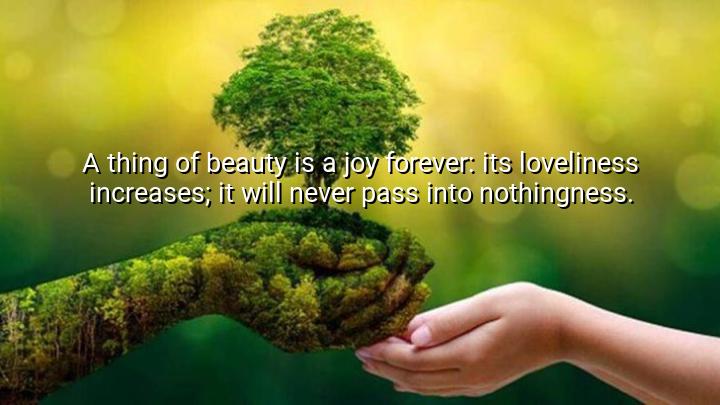




The quote by John Keats, “A thing of beauty is a joy forever: its loveliness increases; it will never pass into nothingness,” beautifully captures the enduring and timeless nature of beauty. Keats suggests that true beauty—whether found in art, nature, or human experience—brings lasting joy that transcends time. Unlike fleeting pleasures, a genuine thing of beauty continues to enrich our lives, growing in significance and impact as we revisit it, and never truly disappearing from our memories or hearts.
John Keats, one of the most celebrated Romantic poets of the early 19th century, wrote this line in his famous poem “Endymion.” The Romantic movement, of which Keats was a key figure, emphasized the importance of emotion, nature, and the sublime. This quote reflects his belief that beauty holds a profound, almost spiritual power—it offers comfort, inspiration, and a sense of immortality in an ever-changing world.
Keats’ use of the phrase “joy forever” suggests that beauty has an enduring quality that provides continuous pleasure and meaning throughout one’s life. Its “loveliness increases” implies that with time and reflection, our appreciation deepens rather than fades. The idea that beauty “will never pass into nothingness” underscores the Romantic ideal that beauty is eternal, resisting the decay and oblivion that affect material things.
Ultimately, this quote invites us to cherish beauty in all its forms, recognizing it as a source of lasting enrichment and hope. Keats reminds us that beauty’s true power lies in its ability to connect us across time, sustaining joy and wonder beyond the moment of its initial encounter.

AAdministratorAdministrator
Welcome, honored guests. Please leave a comment, we will respond soon