

A man should be mourned at his birth, not at his death.
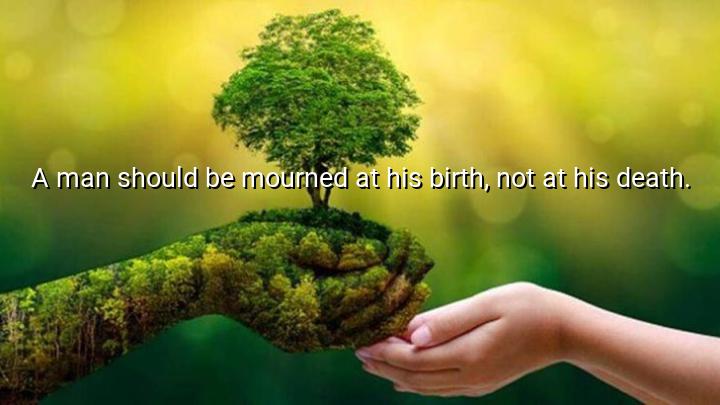




The quote "A man should be mourned at his birth, not at his death" by Montesquieu expresses a profound philosophical view on the nature of life and death. Montesquieu, a French philosopher known for his work on political theory, suggests that the true sorrow lies not in death, which is a natural part of life, but in the birth of an individual. His perspective implies that the hardships, struggles, and challenges that a person faces throughout life are often more deserving of our mourning than the inevitability of death itself. Birth, in this sense, marks the beginning of a life that will inevitably be filled with suffering, challenges, and imperfections, making it a more fitting moment for grief than the end.
Montesquieu’s statement also reflects a more stoic or realist view of human existence. Rather than focusing on the death of an individual, he suggests that we should mourn the moment when a person is born into a world full of struggle and uncertainty. It highlights the difficulties of life, suggesting that these are more significant to acknowledge than the eventual death that will come to everyone. His quote invites us to reconsider the way we perceive life and death, urging us to focus on the challenges we face in between.
The origin of this quote comes from Montesquieu, a philosopher best known for his works such as The Spirit of the Laws, which deeply influenced political thought, especially regarding the separation of powers in governance. Montesquieu’s reflections on human nature and society often carried a tone of realism, where he looked at life through a critical and philosophical lens. This quote, in particular, shows his view on human suffering and the inevitable hardships that come with being alive.
Ultimately, Montesquieu’s quote challenges the traditional view that death should be mourned, proposing instead that we should focus our sorrow on the moment of birth, which introduces a person to a world of difficulty and uncertainty. It serves as a reminder of the complexities of life and the human condition, urging us to reflect on what we truly mourn in the course of our existence.

AAdministratorAdministrator
Welcome, honored guests. Please leave a comment, we will respond soon