

A man may imagine things that are false, but he can only understand things that are true, for if the things be false, the apprehension of them is not understanding.
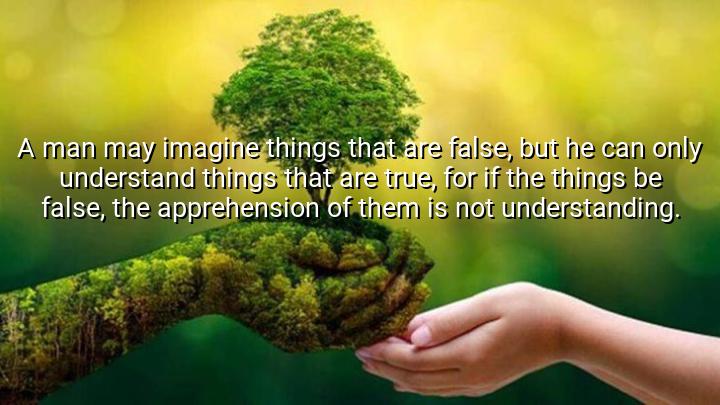




In this quote, Isaac Newton distinguishes between imagination and understanding. He suggests that a person can imagine things that are false, meaning they can conceive ideas, scenarios, or concepts that are not grounded in reality. However, true understanding is only possible when the ideas or concepts align with truth. If the things a person imagines are false, their apprehension or grasp of them does not lead to genuine understanding.
Newton’s point is that the process of understanding requires a connection to reality and truth. Imagination may allow one to create fictitious or speculative ideas, but understanding demands that those ideas be rooted in what is factual and verifiable. Without this foundation in truth, the mind’s grasp of an idea is superficial, and it cannot be considered true understanding.
The quote also reflects Newton's scientific perspective, where he believed that knowledge and understanding are based on rigorous observation and reasoning, not mere speculation or fantasy. He saw truth as something that must be validated by evidence and reason, contrasting with the imaginative fabrications that might not withstand scrutiny or reflection.
Ultimately, Newton’s statement highlights the importance of truth in achieving genuine knowledge. While imagination can explore endless possibilities, it is through truth that we reach true understanding. His quote reflects the foundational principle of scientific inquiry: that real understanding arises only when ideas are tested against the realities of the world, not just imagined without basis.

AAdministratorAdministrator
Welcome, honored guests. Please leave a comment, we will respond soon