

A man can live and be healthy without killing animals for food; therefore, if he eats meat, he participates in taking animal life merely for the sake of his appetite.
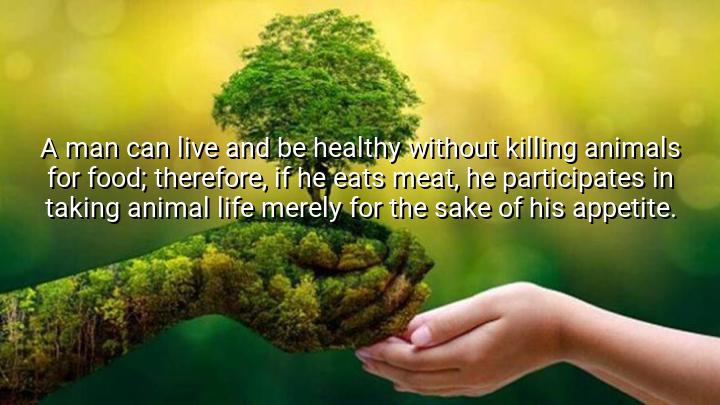




The quote "A man can live and be healthy without killing animals for food; therefore, if he eats meat, he participates in taking animal life merely for the sake of his appetite." by Leo Tolstoy presents a strong ethical argument against meat consumption. Tolstoy emphasizes that since it is possible to maintain health without eating meat, choosing to consume it is a conscious decision that involves the unnecessary taking of animal life. This perspective challenges people to consider the moral implications of eating meat and questions whether appetite justifies the harm caused to animals.
Leo Tolstoy, a renowned Russian author and philosopher, was deeply concerned with issues of morality, nonviolence, and spirituality. Later in his life, he became an advocate for vegetarianism, believing that compassion for all living beings was essential to ethical living. This quote reflects his conviction that humans have a responsibility to avoid causing suffering when alternatives exist, urging a shift toward more humane dietary choices.
The quote also highlights the idea of personal responsibility in ethical decisions. Tolstoy points out that eating meat is not an unavoidable necessity but a choice influenced by desire, and thus individuals should reflect on the consequences of their food habits. His words encourage a mindful approach to eating that considers the broader impact on animals and the environment.
In summary, Tolstoy’s statement is a powerful ethical challenge that promotes compassion and nonviolence through dietary choices. It invites readers to reconsider their relationship with food and to recognize that choosing to eat meat involves a moral dimension beyond mere nutrition or pleasure.

AAdministratorAdministrator
Welcome, honored guests. Please leave a comment, we will respond soon