

You were made perfectly to be loved - and surely I have loved you, in the idea of you, my whole life long.
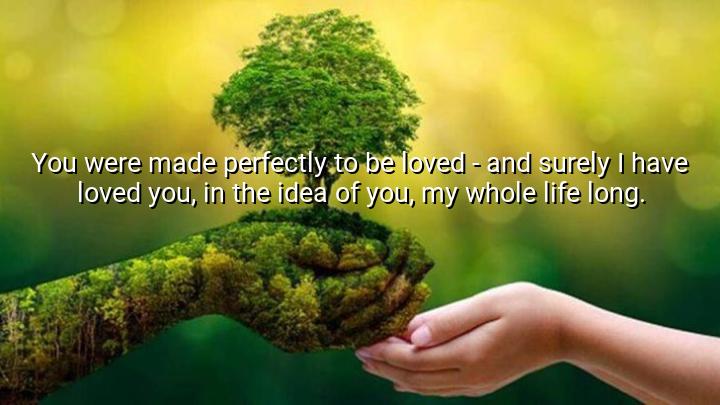




In this quote, Elizabeth Barrett Browning speaks to the deep and timeless nature of her love for the person she addresses. She suggests that the individual was "made perfectly to be loved," highlighting the worthiness of love that comes from the very essence of the person. The phrase "in the idea of you" reveals that Browning’s affection extends beyond the physical presence of the person; it encompasses her imagined and idealized love, which she has carried with her for a long time, even before knowing the person intimately.
Browning’s statement reflects a romantic and idealistic view of love, where the connection with someone is seen as destined or fated. Her expression of love, "in the idea of you," indicates that she has loved this person in her mind and heart long before their actual meeting or relationship, suggesting an eternal or spiritual bond. This idea reinforces the notion that love is not only a physical or present emotion but also a deep, lifelong feeling that transcends time and space.
The origin of this quote comes from Browning’s sonnet from her famous work, "Sonnets from the Portuguese". These sonnets were written during her early, intense love affair with her husband, Robert Browning, and they reflect her passionate and often idealized feelings for him. The sonnets are known for their emotional depth, and this quote speaks to the timeless nature of love as something that can be felt even before it is fully realized in the physical world.
Ultimately, Browning’s quote emphasizes the concept of destined love—a love that is not limited by time or physical presence, but is a part of one's essence and identity. It highlights the profound emotional connection that can exist even in the idea or thought of someone, suggesting that love is something inherent and eternal. This romantic and poetic perspective on love invites reflection on the power of emotional and spiritual bonds that transcend the material world.

TTtrang tran
The timeless quality of this sentiment makes me think about how love transcends time and physical presence. How do people keep love alive in memory or spirit when separated by distance, loss, or circumstance? Can loving someone ‘in the idea’ be a source of comfort and strength?
CNNguyen Tran Canh Nam
I wonder about the emotional complexity behind loving an idea versus loving reality. Could this form of love protect someone from pain, or might it prevent fully engaging with a partner’s authentic self? How do people navigate the balance between imagination and reality in their romantic feelings?
TL24 - Khieu Tung Lam
This quote touches on themes of permanence and ideal beauty in love. How does the concept of loving someone ‘perfectly’ interact with the imperfections inherent in human relationships? Can striving for perfection enhance intimacy, or does it create unrealistic pressures?
HNDinh Hoang Nam
I’m intrigued by the notion of loving someone throughout one’s life in an abstract sense. How might this kind of enduring love influence personal growth or artistic expression? Can loving ‘the idea’ of someone be a way to preserve hope or inspiration even when physical presence is absent?
MNDac Minh Nguyen
The phrase ‘made perfectly to be loved’ is both comforting and profound. Does this suggest an inherent worthiness in everyone, or could it set high expectations for how love should be expressed and received? How do we reconcile this ideal with experiences of rejection or unrequited love?