

Without the emotion of the beautiful, the sublime, the mysterious, there is no art, no religion, no literature.
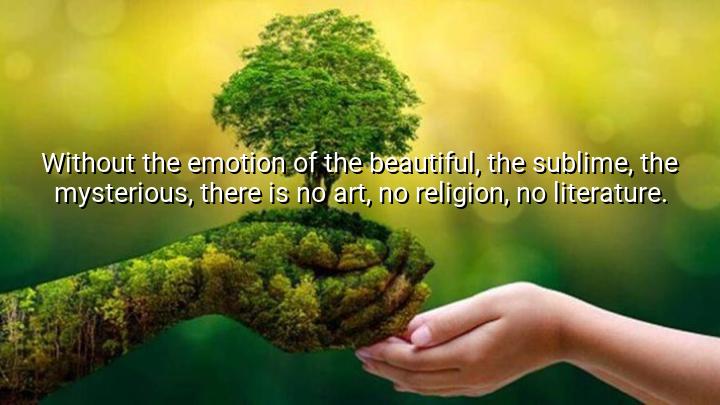




In this quote, John Burroughs, an American naturalist and essayist, emphasizes the essential role of emotion in human expression and experience, particularly in the realms of art, religion, and literature. He argues that without the emotional connection to the beautiful, the sublime, and the mysterious, these human endeavors would cease to exist. For Burroughs, it is the deep feeling evoked by these qualities that gives rise to true creativity, spirituality, and meaningful narrative. Without such emotions, these aspects of culture would be dry, mechanical, or lacking in profound significance.
Burroughs’ statement suggests that the aesthetic experience—which connects us to beauty, wonder, and the unknown—is what gives art, religion, and literature their power. These forms of expression are not merely intellectual or functional but are deeply rooted in the ability to stir the soul and engage the imagination. Whether through paintings, religious rituals, or stories, the human capacity to feel awe, mystery, or reverence is what imbues these creations with their transformative and emotional impact.
The origin of this quote comes from Burroughs’ writings on the relationship between humans and the natural world, as well as his reflections on the role of emotion in aesthetic and spiritual life. Burroughs, often considered a nature writer, was influenced by the Transcendentalist movement, which emphasized the interconnectedness of nature, emotion, and spirituality. His works focus on the importance of feeling and intuition in experiencing both the natural world and human creativity.
Ultimately, Burroughs’ quote underscores the centrality of emotion in human endeavors. Without the emotional responses that connect us to the beautiful and the mysterious, there would be no motivation to create art, engage in religious practices, or craft stories. These pursuits, in his view, are deeply tied to our emotional responses to the world, and it is through these feelings that we find meaning, connection, and transformation in both our inner and outer lives.

AAdministratorAdministrator
Welcome, honored guests. Please leave a comment, we will respond soon