

Without philosophy man cannot know what he makes; without religion he cannot know why.
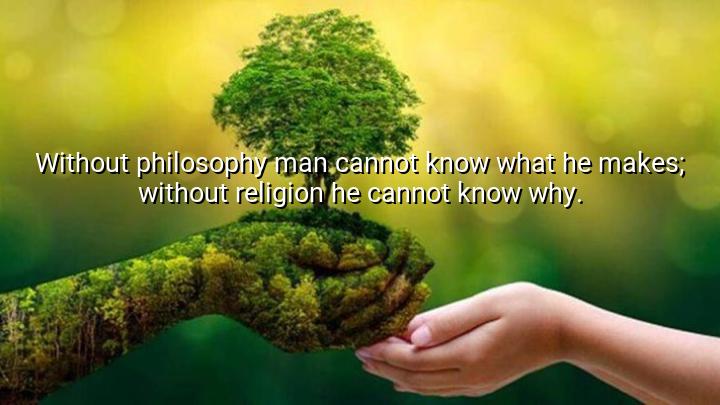




The quote "Without philosophy man cannot know what he makes; without religion he cannot know why" by Eric Gill emphasizes the complementary roles of philosophy and religion in understanding both the nature and purpose of human existence. Gill suggests that philosophy provides the tools for comprehending the mechanisms of the world—what we create and how we operate—while religion offers the moral framework or purpose behind our actions. In this view, philosophy answers the "what" by explaining the logical and intellectual aspects of life, while religion answers the "why," providing the deeper spiritual and ethical reasons for our endeavors.
Eric Gill, a British artist, sculptor, and typographer, was also known for his interest in religion and philosophy, particularly Christian themes. His quote reflects his belief in the interconnectedness of intellectual and spiritual pursuits. Gill's own life and work combined artistic expression with a deep engagement in religious and philosophical thought, and this quote distills his view that these two domains are essential for understanding the full scope of human experience. In his perspective, philosophy and religion are not opposing forces but two necessary components of a balanced life of inquiry and purpose.
The origin of this quote can be traced to Gill's philosophical and theological reflections. As a Christian, Gill saw religion as a guide for the moral and spiritual aspects of life, while philosophy could help explain the practical and intellectual aspects. His statement highlights the tension between the empirical world of reason, governed by philosophy, and the transcendent world of faith and meaning, guided by religion. For Gill, a person who relies solely on reason may understand how things work but will lack a deeper sense of their purpose, whereas a person who focuses only on religion may lack the intellectual tools to understand the world around them.
In essence, this quote calls for a holistic approach to life—one that integrates philosophical inquiry with religious reflection. It suggests that both reason and faith are necessary for a complete understanding of the world, offering both the how and the why of human existence. Without philosophy, we might understand our creations without truly understanding their significance, and without religion, we risk losing sight of the deeper purpose behind everything we do.

AAdministratorAdministrator
Welcome, honored guests. Please leave a comment, we will respond soon