

Wherever technology reaches its real fulfillment, it transcends into architecture.
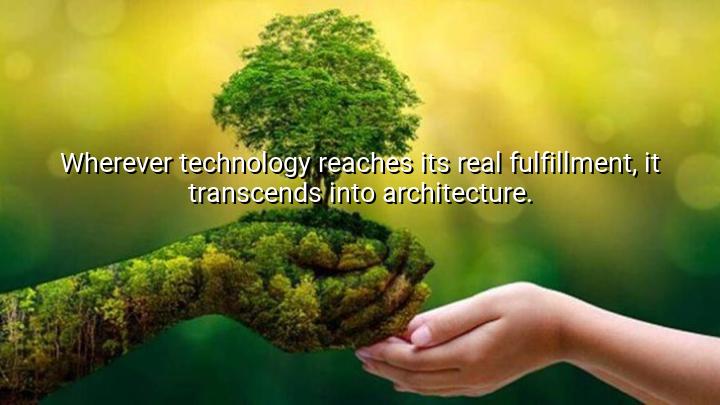




The quote by Ludwig Mies van der Rohe, “Wherever technology reaches its real fulfillment, it transcends into architecture,” highlights his belief in the intimate relationship between technology and architecture. Mies, one of the pioneers of modernist architecture, viewed technology not as a separate or utilitarian tool, but as a foundation for artistic and spatial expression. When technology is fully realized—not just as function, but as form and idea—it becomes more than machinery or engineering; it transforms into architecture, an expression of human aspiration.
By saying technology “transcends” into architecture, Mies emphasizes a philosophical leap—a point where pure technical solutions evolve into artistic and cultural symbols. This concept is key to understanding his famous approach of “less is more.” He sought elegance and clarity through minimalism, material honesty, and structural precision, believing that modern materials like steel and glass could articulate a new architectural language when used with integrity and vision.
His buildings, such as the Barcelona Pavilion and the Seagram Building, embody this principle. These structures are not just technological feats; they are celebrated for their aesthetic refinement, spatial order, and timeless presence. Mies showed that when technology is no longer forced or decorative, but integrated seamlessly, it produces architectural beauty—a result where engineering and design become indistinguishable.
The origin of this quote lies in Mies’s lectures and writings, particularly in his reflections on the role of modern architecture in an age shaped by industrial progress. As a central figure of the Bauhaus movement and later a leader at the Illinois Institute of Technology, Mies consistently advocated for architecture that embraced its time—modern, rational, and yet poetic. This quote encapsulates his lifelong pursuit: to elevate the products of technical mastery into works of enduring architectural art.

AAdministratorAdministrator
Welcome, honored guests. Please leave a comment, we will respond soon