

What finally is beauty? Certainly nothing that can be calculated or measured. It is always something imponderable, something that lies between things.
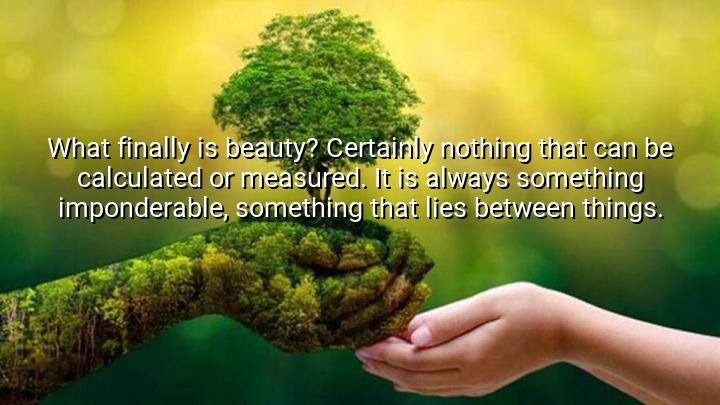




The quote "What finally is beauty? Certainly nothing that can be calculated or measured. It is always something imponderable, something that lies between things" by Ludwig Mies van der Rohe suggests that beauty cannot be understood or defined by logical or scientific means alone. Mies van der Rohe, a renowned architect, emphasizes that beauty transcends objective criteria and cannot be confined to specific formulas or measurements. Instead, it exists as an elusive and intangible quality that defies precise definition or quantification.
The use of the word imponderable suggests that beauty is something that cannot be easily grasped or weighed. It is not a concrete concept that can be measured, like dimensions or physical properties, but rather something that exists in a more abstract and emotional realm. According to Mies van der Rohe, beauty is found in the space between things, suggesting that it emerges from the relationships and interactions between elements, rather than from any single object or form.
By stating that beauty "lies between things," Mies van der Rohe emphasizes the interconnectedness of elements that contribute to its experience. In architecture, for example, beauty may arise from the way materials, light, and space interact, creating an environment that evokes a certain feeling or emotional response. It’s the subtle nuances of design and the harmony between different components that result in a beautiful experience, rather than any single measurable factor.
Ultimately, this quote reflects Mies van der Rohe’s belief that beauty is not a rigid or calculable concept but rather a subjective and experiential quality. It encourages us to appreciate beauty as something that exists in the intangible, the spaces and moments between objects and experiences, which cannot be reduced to numbers or formulas. Beauty, in his view, is a deeply personal and emotional experience, shaped by context, perception, and the interplay of various elements.

AAdministratorAdministrator
Welcome, honored guests. Please leave a comment, we will respond soon