

When you're dead, you're dead. That's it.
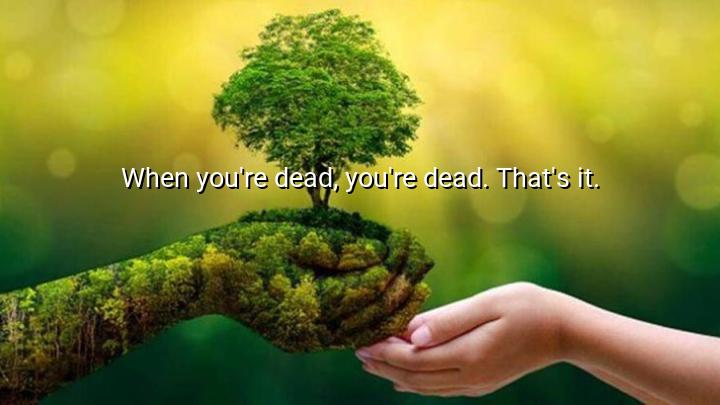




The quote "When you're dead, you're dead. That's it." by Marlene Dietrich presents a blunt and straightforward view of death. Dietrich, known for her bold personality and sharp wit, expresses the finality of death in a no-nonsense manner. She suggests that once life is over, there is no more to it—no afterlife, no unfinished business, just an end. This reflects a realistic or even skeptical perspective on the concept of life and death, where the focus is on the finality of death as an irreversible state.
The origin of this quote comes from Dietrich’s own persona, shaped by her career in film and cabaret. As a German-American actress and singer, Dietrich was known for her confidence and for challenging conventional norms, particularly around topics like fame, femininity, and mortality. This statement fits her style—direct, unapologetic, and free from romanticizing the end of life. It reflects her ability to address serious subjects without sentimentality.
Dietrich’s words also express an element of acceptance about death. In stating that "that's it," she implies that there is no need for fear or worry about the end. It’s a matter-of-fact approach to death, signaling that, once it comes, there is nothing more to ponder. This can be seen as a form of reassurance, encouraging individuals to live fully in the present, without excessive focus on what happens after life ends.
In essence, this quote speaks to finality, acceptance, and clarity in the face of mortality. Dietrich’s unflinching statement about death serves as a reminder that life is to be valued and lived fully, because death, in her view, is a simple and conclusive end.

AAdministratorAdministrator
Welcome, honored guests. Please leave a comment, we will respond soon