

When you look at Japanese traditional architecture, you have to look at Japanese culture and its relationship with nature. You can actually live in a harmonious, close contact with nature - this very unique to Japan.
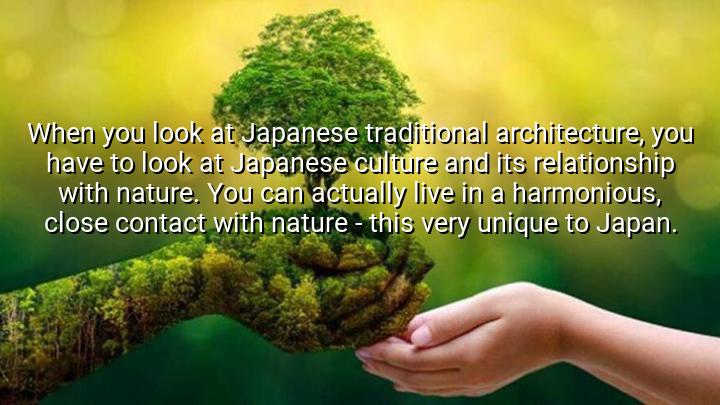




The quote "When you look at Japanese traditional architecture, you have to look at Japanese culture and its relationship with nature. You can actually live in a harmonious, close contact with nature – this is very unique to Japan" by Tadao Ando reflects the profound connection between architecture, culture, and nature in Japanese tradition. Ando, a world-renowned Japanese architect known for his minimalist and spiritually resonant designs, emphasizes that to truly understand Japanese architecture, one must first understand the cultural philosophy that shapes it—particularly the deep reverence for the natural world.
In traditional Japanese architecture, structures are not meant to dominate the environment, but to exist in harmony with it. This is evident in design features like sliding screens, engawa (verandas), natural materials, and the seamless flow between indoor and outdoor spaces. Ando celebrates this relationship as something "unique to Japan," where living close to nature is not only aesthetically pleasing but deeply spiritual and philosophical, rooted in concepts like Shintoism, Zen Buddhism, and wabi-sabi.
Ando's own architectural works, such as the Church of the Light or Naoshima’s art museums, continue this tradition by integrating light, wind, water, and raw materials in a way that elevates the human experience and fosters contemplation. His quote underscores the idea that architecture is not just about buildings, but about creating a lifestyle and worldview—one where humans live in respectful coexistence with nature rather than in opposition to it.
Ultimately, this quote is a reminder that cultural values are embedded in the way spaces are designed and inhabited. For Ando, Japanese traditional architecture is not merely a style—it is a philosophical expression of how one should live: in closeness, balance, and harmony with the natural world. This approach continues to inspire contemporary designers around the globe seeking more sustainable and human-centered design.

AAdministratorAdministrator
Welcome, honored guests. Please leave a comment, we will respond soon