

You cannot simply put something new into a place. You have to absorb what you see around you, what exists on the land, and then use that knowledge along with contemporary thinking to interpret what you see.
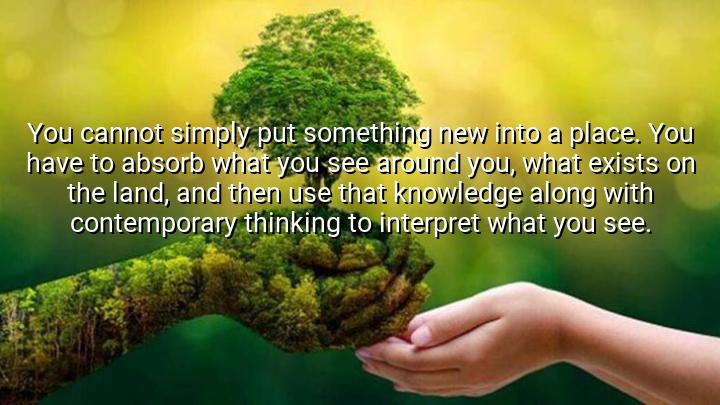




The quote by Tadao Ando, “You cannot simply put something new into a place. You have to absorb what you see around you, what exists on the land, and then use that knowledge along with contemporary thinking to interpret what you see,” emphasizes the importance of context and observation in creative work. Ando suggests that true innovation does not happen in isolation; it requires a deep understanding of the existing environment and the ability to integrate that knowledge with modern ideas to create meaningful designs or interventions.
Ando, a renowned Japanese architect, is known for his minimalist and context-sensitive designs that harmonize with natural landscapes and urban environments. In this quote, he highlights his approach to architecture: rather than imposing arbitrary structures, one must first observe and understand the surrounding landscape, culture, and existing conditions. This ensures that new creations resonate with their environment and carry deeper significance.
The origin of this quote lies in Ando’s philosophy of architecture, which combines traditional Japanese sensibilities with contemporary design principles. He often emphasizes the dialogue between nature, history, and modernity, advocating for a thoughtful integration of knowledge and creativity. For Ando, absorption of context is a crucial step in producing designs that are both innovative and respectful of their surroundings.
Ultimately, Ando’s insight reminds us that meaningful creation requires more than innovation alone. It demands careful observation, understanding of existing conditions, and the application of both knowledge and contemporary thought to interpret and enhance the world around us. The quote underscores that true design is a balance of awareness, insight, and creativity.

AAdministratorAdministrator
Welcome, honored guests. Please leave a comment, we will respond soon