

When I do good I feel good, when I do bad I feel bad, and that's my religion.
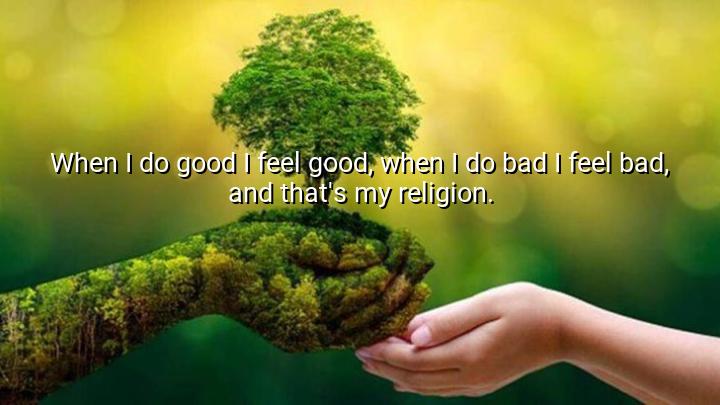




The quote "When I do good I feel good, when I do bad I feel bad, and that's my religion" by Abraham Lincoln reflects his deeply personal approach to ethics and morality. In this simple yet profound statement, Lincoln suggests that his sense of right and wrong is guided by an inner moral compass—the feeling of good and bad actions on his conscience. He doesn’t rely on complex doctrines or external authority to define his actions; instead, he trusts his own ability to discern what is right based on how it makes him feel internally.
Lincoln’s concept of religion in this context is not about formal practices or institutions, but about a personal, internal understanding of what it means to live ethically. He sees goodness as something that brings an inherent sense of fulfillment and peace, while wrongdoing causes a natural feeling of guilt or discomfort. In essence, his "religion" is the pursuit of personal integrity and living in alignment with one’s conscience, rather than adhering to prescribed rituals or beliefs.
The origin of this quote stems from Lincoln’s well-known character as a man of strong principles. Throughout his life, he was known for his honesty, empathy, and moral clarity, particularly during his presidency. His actions, such as the abolition of slavery, reflect his commitment to doing what he believed was right, even when faced with enormous challenges. This quote encapsulates his belief that our actions and their emotional consequences are the true measure of our moral lives.
Ultimately, Lincoln’s statement suggests that self-awareness and personal accountability are central to moral living. Instead of relying on external authority or rigid rules, he believed that the emotional feedback we get from our actions—whether we feel good or bad—guides us toward a life of integrity and authenticity. In this sense, his religion is rooted in an ethical framework that is universal and accessible to all.

AAdministratorAdministrator
Welcome, honored guests. Please leave a comment, we will respond soon