

When a deep injury is done us, we never recover until we forgive.
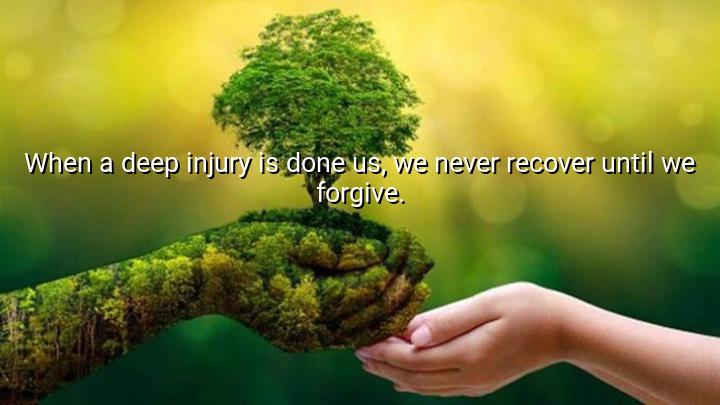




The quote "When a deep injury is done us, we never recover until we forgive" by Alan Paton emphasizes the healing power of forgiveness in the face of hurt and trauma. Paton suggests that holding onto deep emotional wounds, whether caused by betrayal, injustice, or personal loss, prevents us from truly recovering and finding peace. Forgiveness, according to Paton, is not just an act of letting go of resentment but a necessary step toward emotional and psychological healing, allowing individuals to move forward and regain a sense of wholeness.
Paton’s quote highlights the importance of releasing the grip of anger and grudge that often accompanies deep injury. While it may be difficult, forgiving the one who has caused harm helps us to free ourselves from the emotional burden of holding onto pain. Forgiveness, in this sense, is not about excusing the offense but about freeing ourselves from its continued emotional hold. It’s about reclaiming control over our own emotional well-being rather than allowing the injury to define us.
The origin of this quote comes from Alan Paton, a South African writer and anti-apartheid activist best known for his novel "Cry, the Beloved Country". Paton’s work often dealt with themes of justice, reconciliation, and the power of forgiveness in the face of systemic and personal suffering. His experiences in South Africa, especially witnessing the effects of apartheid, likely influenced his belief that forgiveness is a critical path to healing both individual wounds and societal rifts.
In essence, Paton’s quote serves as a reminder that forgiveness is a key part of emotional recovery. Only by letting go of resentment and embracing forgiveness can we heal from the deep injuries life may inflict. It’s not just a gift to the person who wronged us, but a liberating gift to ourselves, allowing us to move forward without being trapped by the past.

AAdministratorAdministrator
Welcome, honored guests. Please leave a comment, we will respond soon