

Whatever our souls are made of, his and mine are the same.
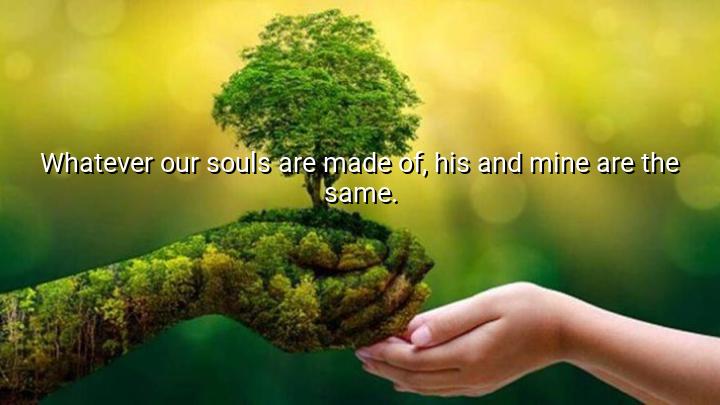




The quote by Emily Brontë, “Whatever our souls are made of, his and mine are the same,” reflects the profound spiritual and emotional connection between two people in love. Brontë emphasizes that true intimacy transcends physical attraction or social circumstance; it is the soul-level affinity that defines the deepest bonds. This suggests that love is not only a matter of circumstance or choice but an intrinsic recognition of shared essence between two individuals.
By asserting that their souls are the same, Brontë conveys a sense of unity, mutual understanding, and destiny. The quote implies that authentic love is rooted in compatibility at the deepest level, creating a bond that is timeless and unbreakable. It celebrates the rare and extraordinary nature of such connections, highlighting the intensity and purity of emotional and spiritual intimacy.
The origin of this quote is Brontë’s novel “Wuthering Heights,” published in 1847. The line reflects the passionate and tumultuous relationship between Catherine Earnshaw and Heathcliff, emphasizing the idea of love as a force that binds souls beyond societal norms, material concerns, or even mortality. Brontë’s exploration of love, obsession, and identity in the novel made this quote an enduring statement on the power of soulful connection.
Overall, the quote illustrates Brontë’s belief in the transcendent power of love. By describing love as the recognition of a shared soul essence, she conveys that true intimacy is about spiritual alignment and emotional unity, elevating love from mere attraction to a profound, almost mystical experience.

AAdministratorAdministrator
Welcome, honored guests. Please leave a comment, we will respond soon