

Having leveled my palace, don't erect a hovel and complacently admire your own charity in giving me that for a home.
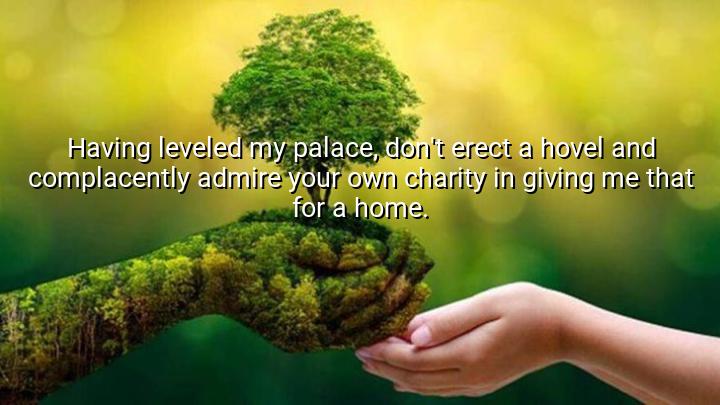




In this quote, Emily Brontë expresses a powerful sentiment about the value of respect and dignity in relationships and personal sacrifice. The phrase “leveled my palace” symbolizes the destruction or loss of something valuable, perhaps a sense of security or comfort. Brontë warns that after taking something significant away, one should not replace it with something inferior—a hovel—and expect gratitude or admiration. Instead of seeing the new, lesser offering as an act of charity, she emphasizes the importance of genuine care and effort, rather than complacency in providing something that still falls short of what was lost.
Brontë's words also point to the concept of sacrifice and the balance in relationships. The phrase “complacently admire your own charity” suggests that when someone offers a replacement, they should not do so with a sense of self-congratulation or superiority. This reflects a critique of those who feel entitled to praise for their actions, particularly when they fail to fully understand the emotional weight or need of the other person. True charity is not about making oneself feel good, but about giving what is truly needed.
The imagery of a palace being replaced by a hovel conveys the idea of loss and the inadequacy of a quick or superficial fix. Brontë seems to argue that when something of significant value—such as trust, love, or emotional security—is taken away, merely providing a token replacement is insufficient. The quality of what is given should reflect the importance of what was lost, not just the donor’s desire to appear generous.
Ultimately, this quote speaks to the themes of respect, genuine sacrifice, and the emotional depth of relationships. It warns against offering something less than what is needed or deserved, and critiques the self-serving nature of actions that are done without true understanding or effort. Brontë calls for deeper consideration in the way people care for one another, emphasizing that mere gestures are insufficient when what’s truly needed is understanding and respect.

AAdministratorAdministrator
Welcome, honored guests. Please leave a comment, we will respond soon