

What some call health, if purchased by perpetual anxiety about diet, isn't much better than tedious disease.
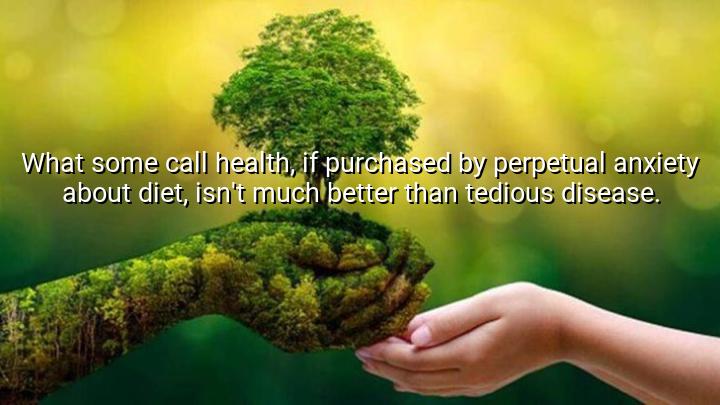




The quote by Alexander Pope, an 18th-century poet, reflects his critique of excessive concern over health and diet. Pope suggests that if maintaining good health requires constant anxiety and obsession over what one eats, then it may not be much better than living with a disease. In this view, the pursuit of health should not come at the cost of mental peace or enjoyment of life. The constant worry about diet and well-being, according to Pope, can lead to a kind of self-imposed suffering, which negates the purpose of seeking health in the first place.
Pope's statement also challenges the notion of health as purely a matter of control and restriction. While many may focus on rigid diets and meticulous health routines, Pope warns that this obsessive behavior can create its own form of stress and mental discomfort. In this sense, he seems to argue that true health involves balance, and that constant worry and overthinking may be more harmful than simply accepting the natural ebb and flow of life and health.
The comparison to disease is significant here because Pope implies that living in a constant state of worry about one’s health can be just as debilitating as having an actual illness. The emotional and mental toll of anxiety may ultimately undermine one’s overall well-being, even if the physical body is technically "healthy." This sentiment reflects Pope’s broader philosophical perspective that human happiness depends not just on the physical state, but also on mental and emotional peace.
In essence, Pope’s quote advocates for a more balanced approach to health—one that doesn’t prioritize constant anxiety or obsession over perfect diets. Health, he suggests, should be about enjoying life and feeling at ease with oneself, rather than succumbing to the stress of trying to achieve an unrealistic standard of perfection.

AAdministratorAdministrator
Welcome, honored guests. Please leave a comment, we will respond soon