

What is it to keep kosher? Is it eating kosher potato chips? Kosher is a bigger idea. I think it's about being healthy. But according to some people, it's about not eating this food because it's forbidden by the Jewish law. My view of the halachah changed a little bit. The laws are there hopefully to be a tool.
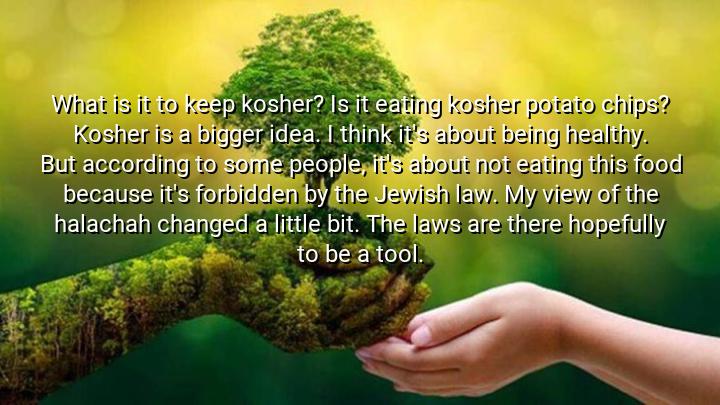




The quote "What is it to keep kosher? Is it eating kosher potato chips? Kosher is a bigger idea. I think it's about being healthy. But according to some people, it's about not eating this food because it's forbidden by the Jewish law. My view of the halachah changed a little bit. The laws are there hopefully to be a tool." by Matisyahu explores the evolving relationship between religious tradition and personal interpretation. Here, the artist reflects on the meaning behind keeping kosher, questioning whether it's only about food restrictions or part of a more profound spiritual and practical philosophy.
Matisyahu, a Jewish-American reggae musician known for blending religious themes with modern music, has publicly shared his spiritual journey — including his shifting views on Judaism, observance, and identity. In this quote, he humorously challenges the narrow understanding of kosher as simply eating specific labeled foods like kosher potato chips, and instead suggests that it encompasses broader ideas of health, mindfulness, and ethical living.
By referencing halachah — the collective body of Jewish law — Matisyahu implies that these ancient rules shouldn't be followed blindly, but rather understood as tools for living a meaningful life. His evolving view points to a personal and dynamic approach to faith, where tradition is balanced with individual reasoning and modern values. For him, the laws are not about rigid obedience but about enhancing one’s physical and spiritual well-being.
This quote likely comes from an interview where Matisyahu discussed his transformation from strict religious observance to a more fluid spiritual practice. It resonates with many contemporary believers who seek to reinterpret religious practices in a modern context. His words encourage thoughtful engagement with tradition — seeing kosher not just as a checklist, but as a concept rooted in awareness, discipline, and intention.

AAdministratorAdministrator
Welcome, honored guests. Please leave a comment, we will respond soon