

What happens when good people are put into an evil place? Do they triumph or does the situation dominate their past history and morality?
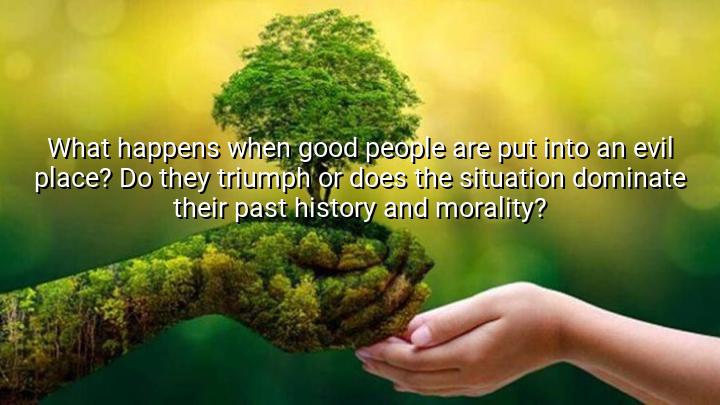




Philip Zimbardo’s quote—“What happens when good people are put into an evil place? Do they triumph or does the situation dominate their past history and morality?”—explores the psychological effects of situational influences on human behavior. Zimbardo is asking whether individuals with a strong moral foundation can maintain their integrity when placed in corrupt or harmful environments, or if the evil of their surroundings can overpower their history and moral values. The question challenges the notion of inherent goodness and probes the complexities of human behavior when confronted with extreme situations.
The origin of this quote comes from Zimbardo’s work as a psychologist, particularly his famous Stanford Prison Experiment in 1971. The experiment sought to explore the effects of power dynamics and role-playing on human behavior. Zimbardo set up a simulated prison environment, assigning participants to roles as either guards or prisoners. The results showed that even those with no history of aggressive behavior quickly adopted harmful roles, with guards becoming abusive and prisoners suffering psychologically. This experiment suggested that situational forces can deeply influence individuals, potentially overshadowing their moral values and personal histories.
By asking whether the situation dominates one’s history and morality, Zimbardo is reflecting on the power of environmental factors in shaping behavior. His research suggests that people can be swayed by the circumstances they find themselves in, often acting in ways that contradict their usual moral principles. This leads to broader discussions on human nature and the ethics of creating environments that can lead to harmful behaviors.
Ultimately, Zimbardo’s quote raises important questions about personal responsibility, morality, and the power of external influences. It challenges the belief that individuals are entirely in control of their actions, pointing out that sometimes the evil of a given place can erode even the most steadfast moral compass. His work reminds us that history, morality, and individual actions are often deeply intertwined with the situations we face, offering crucial insights into the complexities of human behavior in extreme circumstances.

AAdministratorAdministrator
Welcome, honored guests. Please leave a comment, we will respond soon