

We want to answer this classical question, who am I? So I think that most of our works are for art, or whatever we do, including science or religion, tried to answer that question.
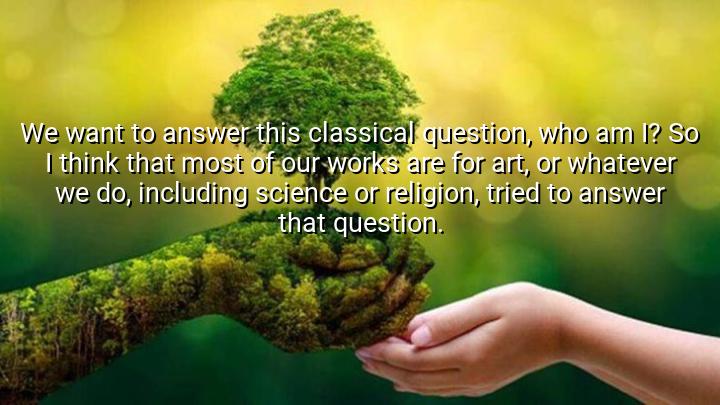




The quote by Paulo Coelho speaks to the deep, universal human quest for identity and self-understanding. The question "who am I?" is one of the most fundamental and existential inquiries that drives much of human behavior, whether through art, science, or religion. Coelho suggests that everything we create or seek—whether in the realm of creative expression, intellectual discovery, or spiritual belief—ultimately aims to answer this profound question. The search for meaning and purpose in life, in his view, transcends specific disciplines and connects them all to a broader journey of self-realization.
Coelho, known for his spiritual novels like The Alchemist, often explores the theme of personal growth and the pursuit of one's true self. In this quote, he reflects on the fact that every human endeavor, from the arts to scientific exploration, is motivated by the desire to understand who we are and why we exist. Art might express emotions and identity, science seeks to understand the nature of life, and religion provides a framework for understanding our spiritual and moral purpose. Each of these paths, according to Coelho, is a response to the same question: "Who am I?"
The origin of this quote can be linked to Coelho's broader philosophical views on the human condition. Throughout his work, he often reflects on the importance of self-discovery and the internal journeys that shape our lives. He sees both the external world and our internal world as connected—what we seek in the world is often a reflection of what we are searching for within ourselves. This quote encapsulates his belief that the pursuit of knowledge, expression, and faith is, at its core, about seeking authenticity and truth.
Ultimately, Coelho’s quote invites us to recognize that the quest for understanding our identity is not confined to one discipline but is woven into every aspect of life. Whether we express it through creativity, reason, or faith, our actions are deeply intertwined with the timeless human desire to discover and affirm who we are in the grand scheme of existence.

AAdministratorAdministrator
Welcome, honored guests. Please leave a comment, we will respond soon