

We tend to be more environmental at home than at work, regardless of the industry we're in.
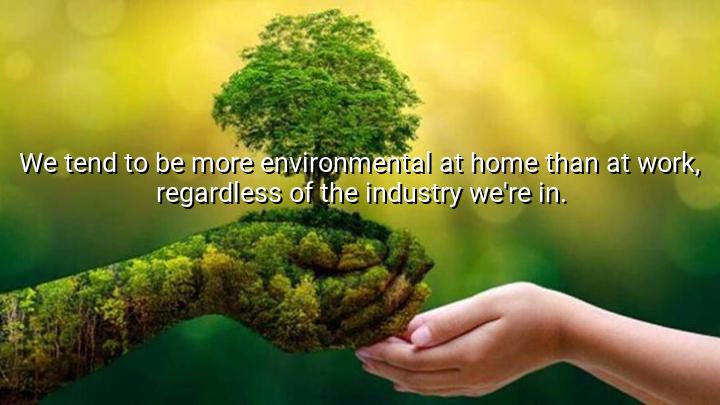




Gale Anne Hurd’s quote, “We tend to be more environmental at home than at work, regardless of the industry we’re in,” highlights the discrepancy between personal and professional environmental practices. Hurd suggests that individuals often adopt more sustainable and eco-friendly behaviors in their personal lives—such as recycling, conserving energy, and reducing waste—than they do in their professional environments. This disparity may be due to a variety of factors, including the constraints of the workplace, where profit-driven goals and operational efficiency can sometimes conflict with environmental concerns.
The quote implies that while many people are increasingly aware of the environmental impact of their actions, they may struggle to implement similar practices at work due to the demands of business operations. In the workplace, resources are often used at larger scales, and sustainability may be viewed as secondary to other priorities, such as cost-cutting, productivity, or profitability. Hurd’s comment suggests a challenge in aligning corporate policies with environmental responsibility, even though individuals might strive to live more sustainably at home.
Gale Anne Hurd, a prominent film producer and environmental advocate, is known for her work on films that often incorporate themes of survival, technology, and the environment, such as The Terminator and The Walking Dead. Her background in the entertainment industry may also influence her observation about how environmental practices are applied differently in personal and professional settings. As someone involved in media, which is both a reflection of and influence on society’s values, Hurd’s perspective points to a broader societal issue regarding corporate responsibility and individual behavior.
In summary, Hurd’s quote reflects the common gap between individual and institutional environmental actions. While people may act more eco-consciously at home, they often face challenges in translating those practices into the workplace due to the priorities of industry and profitability. Hurd’s insight encourages a broader conversation about how both individuals and businesses can take responsibility for creating a more sustainable future, both personally and professionally.

AAdministratorAdministrator
Welcome, honored guests. Please leave a comment, we will respond soon