

We recognise the link between environmental failure and social injustice. When the energy sector is privatised and deregulated, it not only tends to pollute more, it also charges the poorest more per unit!
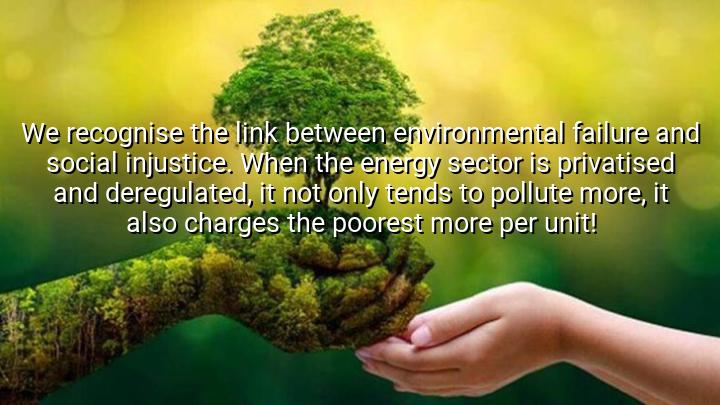




In this quote, Barry Gardiner, a British politician and environmental advocate, draws attention to the connection between environmental failure and social injustice. He argues that when essential industries, like the energy sector, are privatized and deregulated, the negative consequences are twofold: the environment suffers due to reduced oversight and accountability, and the most vulnerable members of society are disproportionately affected. Gardiner highlights how the lack of regulation in the energy industry leads to increased pollution, which harms the environment and public health, while also contributing to economic inequality.
Gardiner emphasizes that privatization and deregulation often result in energy companies prioritizing profits over environmental responsibility. This typically leads to higher emissions and a greater environmental footprint. At the same time, the lack of government regulation means that energy prices are not kept in check, and the poorest consumers end up paying more for energy. This situation creates a scenario where the disadvantaged not only bear the brunt of environmental degradation but also face financial hardship due to inflated energy costs.
By linking environmental failure with social injustice, Gardiner argues that the environmental crisis is not just an ecological issue but also a matter of economic fairness. The poorest populations are often the least able to afford cleaner energy options and the most vulnerable to the negative impacts of environmental degradation. This connection underscores the need for sustainable policies that address both environmental protection and social equity, ensuring that vulnerable groups are not left behind in the transition to a more sustainable future.
Gardiner’s statement is part of a broader call for more responsible and equitable approaches to energy policy. He advocates for government regulation of the energy sector to prevent both pollution and exploitation of low-income consumers, promoting a more just and sustainable society. His views reflect a growing recognition that environmental and social issues are deeply interconnected and must be addressed together.

AAdministratorAdministrator
Welcome, honored guests. Please leave a comment, we will respond soon