

We need better neighbors, neighbors that care about the schools in their neighborhood whether they have kids in them or not, because they know that the health and vitality of that neighborhood depends on it.
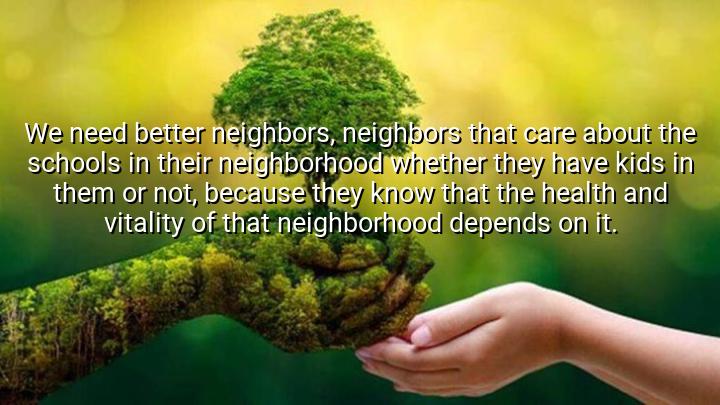




In this quote, Thomas Friedman stresses the importance of community involvement and the role that neighbors play in fostering the health and vitality of a neighborhood. He argues that people should care about the schools in their community, regardless of whether they have children attending them, because the well-being of the neighborhood is interconnected with the quality of its educational system. Friedman suggests that a thriving, strong community depends on everyone’s investment in local resources, including schools, even if they don’t directly benefit from them.
Friedman’s statement highlights the concept of shared responsibility in communities, where individuals recognize that the success of local institutions, like schools, impacts the overall health of the neighborhood. By caring about and supporting the education system, residents can contribute to a stronger, more cohesive community, leading to long-term social stability and prosperity. The idea is that when schools thrive, the entire community benefits, as education is closely tied to economic opportunity, social mobility, and quality of life.
The origin of this quote comes from Friedman’s work as a journalist and author, where he often explores themes of globalization, community engagement, and social responsibility. He has written extensively about how local actions can have global implications, and in this instance, his call for better neighbors speaks to the larger importance of community cohesion and collective action.
In a broader context, Friedman’s quote serves as a reminder of the importance of civic engagement and the interconnectedness of community life. It advocates for a mindset where individuals recognize that their well-being is tied to the health of the community around them. This broader perspective encourages people to think beyond their immediate interests and to invest in the shared resources that sustain a thriving, prosperous neighborhood.

AAdministratorAdministrator
Welcome, honored guests. Please leave a comment, we will respond soon