

We have no reason to think that climate change is harmful if you look at the world as a whole. Most places, in fact, are better off being warmer than being colder. And historically, the really bad times for the environment and for people have been the cold periods rather than the warm periods.
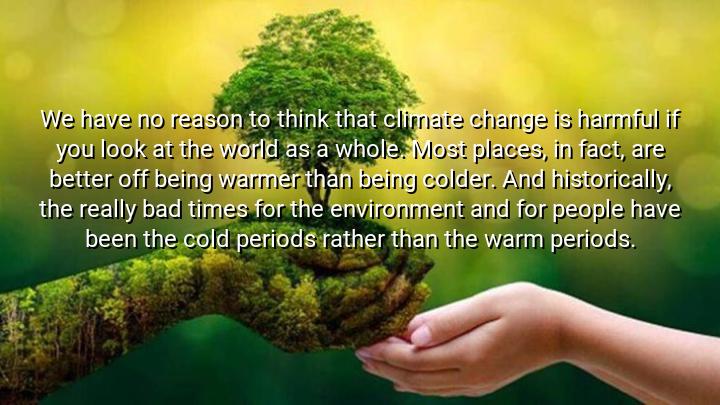




Freeman Dyson’s quote challenges the prevailing view that climate change is universally harmful, offering a different perspective by suggesting that, when considering the world as a whole, some regions might actually benefit from a warmer climate. Dyson argues that higher temperatures can lead to more favorable conditions in certain places, potentially making them more productive or habitable. He contrasts this with cold periods in history, which he claims have historically been more detrimental to both the environment and human societies, resulting in harder living conditions and fewer resources.
The origin of this quote comes from Dyson's work as a theoretical physicist and mathematician, known for his contrarian views on various scientific matters, including climate change. As a researcher who often questioned mainstream scientific consensus, Dyson was critical of some climate change models, arguing that they could be overly alarmist. His position on climate change reflects his broader skepticism about the assumptions that often drive public discourse, particularly when it comes to complex and multifaceted issues like global warming.
Dyson’s statement focuses on the idea that climate change, which often involves a shift toward warmer temperatures, might not be as uniformly destructive as commonly believed. He suggests that rather than causing widespread harm, warming might have localized benefits, such as longer growing seasons, milder winters, and more habitable regions in colder parts of the world. This perspective challenges the dominant narrative of climate catastrophe, offering an alternative view where the effects of climate change could be uneven and context-dependent.
Ultimately, Dyson’s quote raises questions about the complexity of climate change and how its effects might vary across different regions and time periods. While his views are controversial and have been met with criticism from many environmentalists and climate scientists, his statement highlights the need for a broader, more nuanced discussion about climate change. It suggests that the impacts of warming should be evaluated on a global scale, considering both the positive and negative effects across various regions of the world.

AAdministratorAdministrator
Welcome, honored guests. Please leave a comment, we will respond soon