

We cannot create observers by saying 'observe', but by giving them the power and the means for this observation and these means are procured through education of the senses.
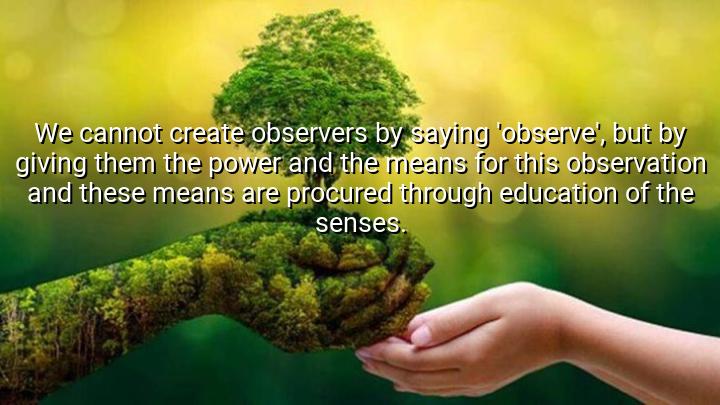




The quote by Maria Montessori, “We cannot create observers by saying ‘observe,’ but by giving them the power and the means for this observation and these means are procured through education of the senses”, emphasizes her belief in experiential learning. Montessori argues that true observation skills cannot be developed by instruction alone. Instead, individuals—especially children—must be equipped with the tools, experiences, and sensory training that enable them to perceive and understand the world deeply.
The origin of this statement comes from Montessori’s groundbreaking work in early childhood education during the late 19th and early 20th centuries. As a physician and educator, she observed that children learn most effectively through direct interaction with their environment. This led her to design materials and teaching methods that sharpen the senses, allowing children to build knowledge through touch, sight, sound, and movement. Her method made observation a natural outcome of active engagement rather than passive instruction.
By stressing education of the senses, Montessori highlights that perception is the foundation of learning. When children develop refined sensory awareness, they gain the power to notice details, patterns, and relationships that would otherwise go unnoticed. This makes them true observers, capable of independent discovery and critical thinking rather than relying solely on external authority for knowledge.
Ultimately, Montessori’s quote reflects her revolutionary approach to education, which values independence, curiosity, and the development of the whole child. For her, giving learners the means to explore their world transforms them into active participants in their own growth, laying the foundation for lifelong learning and self-reliance.

AAdministratorAdministrator
Welcome, honored guests. Please leave a comment, we will respond soon