

We can be thankful to a friend for a few acres, or a little money; and yet for the freedom and command of the whole earth, and for the great benefits of our being, our life, health, and reason, we look upon ourselves as under no obligation.
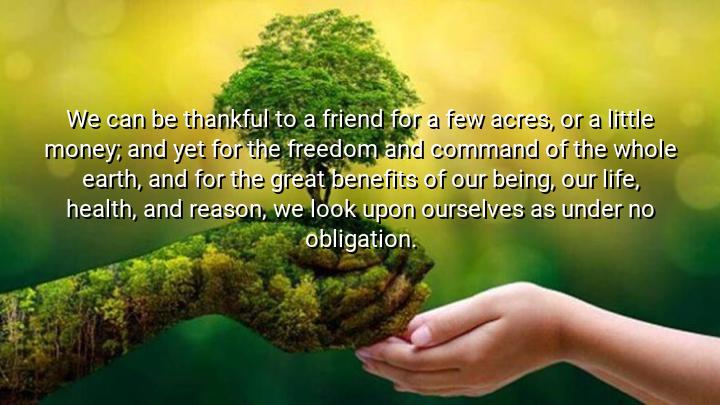




The quote "We can be thankful to a friend for a few acres, or a little money; and yet for the freedom and command of the whole earth, and for the great benefits of our being, our life, health, and reason, we look upon ourselves as under no obligation" by Lucius Annaeus Seneca, a Stoic philosopher, reflects on human nature and our often skewed sense of gratitude. Seneca points out the irony that people are quick to express gratitude for material things such as land or money, which are temporary and finite, but fail to recognize the true gifts of life—freedom, health, and reason—as something to be deeply thankful for, even though these gifts are more enduring and essential.
At its core, the quote highlights the contrast between how we value material possessions versus the intangible, yet invaluable, aspects of life. Seneca critiques how we often take life, health, and the ability to reason for granted, seeing them as inherent rights rather than privileges. These are fundamental to our existence and well-being, yet we seldom acknowledge them with the same level of gratitude as we do material possessions like money or land.
The quote also challenges the reader to reconsider their sense of obligation. Seneca is suggesting that we are often ungrateful for the most important things in life because we assume them to be given or deserved, whereas the things we receive from others—such as friendship or material wealth—are seen as gifts that require gratitude. This lack of recognition for the more significant blessings, such as freedom or health, is a reflection of how we sometimes fail to appreciate what is truly valuable.
Ultimately, Seneca’s quote is a reminder to cultivate a deeper sense of gratitude for the gifts that shape our existence and allow us to thrive—things like freedom, life, and the ability to think and reason. By recognizing these as true blessings, we can foster a greater appreciation for the life we have, rather than focusing solely on what is material and transient.

AAdministratorAdministrator
Welcome, honored guests. Please leave a comment, we will respond soon