

We are punished by our sins, not for them.
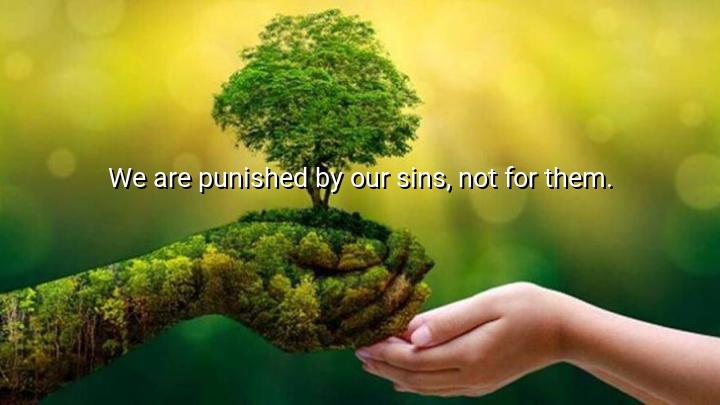




The quote "We are punished by our sins, not for them" by Elbert Hubbard offers a nuanced perspective on the nature of sin and punishment. Hubbard suggests that the consequences of our actions, particularly when we act in ways that are morally wrong or selfish, are a natural result of those actions rather than an external retribution or punishment imposed by some higher power. In this view, the punishment is not something that is deliberately meted out to us, but rather the inevitable outcomes of our own wrongdoings. The suffering we experience as a result of sin is not a punishment "for" our actions, but a natural consequence that arises from making choices that are out of alignment with moral integrity.
Hubbard’s quote emphasizes personal responsibility and the causal link between behavior and its consequences. Rather than focusing on the concept of divine or external punishment, it directs attention to how our own choices lead to difficulties, regrets, or suffering. When we act with selfishness, dishonesty, or harm others, the negative effects are not imposed on us by an outside force but come as a direct result of our actions. In this sense, the true punishment is the guilt, regret, or destruction we experience from having strayed from ethical or compassionate behavior.
The origin of this quote lies in Hubbard’s philosophical approach to life, which was shaped by his focus on individualism and the consequences of personal choices. As a writer, editor, and philosopher, Hubbard often explored themes of self-reliance and personal accountability, believing that humans should take responsibility for their actions and learn from their mistakes. His view of sin, therefore, was not centered on divine punishment, but on the natural law of cause and effect—where bad actions inevitably lead to bad outcomes.
Ultimately, Hubbard’s quote serves as a reminder that the consequences of immoral behavior are not arbitrary punishments, but natural outcomes that arise from the harmful effects of those actions. By focusing on personal responsibility rather than external blame, Hubbard encourages us to reflect on how our choices shape our lives and the lives of those around us. In this way, we are both the creators and the recipients of our own fate.

AAdministratorAdministrator
Welcome, honored guests. Please leave a comment, we will respond soon