

We all require and want respect, man or woman, black or white. It's our basic human right.
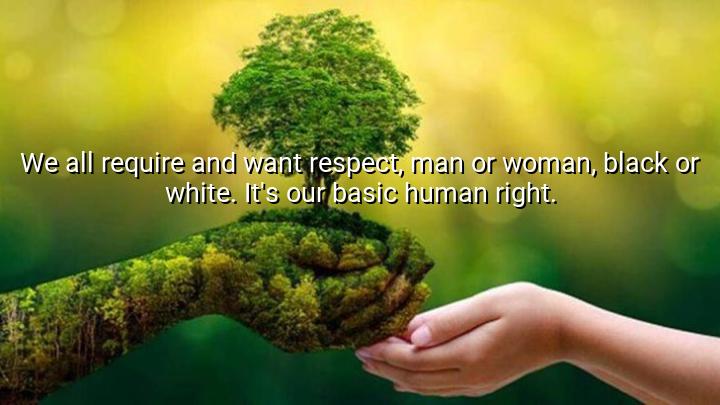




The quote "We all require and want respect, man or woman, black or white. It's our basic human right" by Aretha Franklin speaks to the universal need for dignity and recognition that transcends race, gender, and other societal divisions. Franklin, often regarded as the "Queen of Soul," was a powerful advocate for equality and civil rights, and this quote encapsulates her belief that respect is not conditional on one’s identity or background. She asserts that every individual, regardless of gender or race, deserves to be treated with respect and should be recognized as an equal in society.
Franklin's statement underscores the importance of human rights, specifically the right to be treated with honor and fairness. By mentioning both men and women, as well as black and white individuals, she highlights how societal inequality often creates divisions that deprive people of their inherent worth. This quote calls for the recognition that all people, regardless of their race or gender, are entitled to be respected simply because they are human. Franklin’s own experiences as a Black woman in a racially segregated society informed this belief, making the message deeply personal and rooted in her own fight for justice.
The origin of this quote can be traced back to Franklin's lifelong advocacy for social justice, particularly her support of the civil rights movement. Throughout her career, she used her music as a platform to address issues of race and equality, with iconic songs like "Respect" becoming anthems for both the feminist and civil rights movements. Her statement reflects her desire to see a world where discrimination and prejudice are eliminated and where all people are treated with dignity.
In essence, Franklin’s words remind us that respect is a fundamental right that should be extended to everyone, regardless of their background. She stresses that basic human rights—including the right to be respected—are universal, and it is essential for societies to recognize and uphold these rights for all individuals. Through this message, Franklin calls for a world in which equality is not just an ideal, but a lived reality for everyone.

AAdministratorAdministrator
Welcome, honored guests. Please leave a comment, we will respond soon