

Vegetarians have been around for a very long time - Pythagoreans forbade eating animals more than 2,500 years ago - but even as the environmental evidence mounted, they didn't appear to be winning the argument.
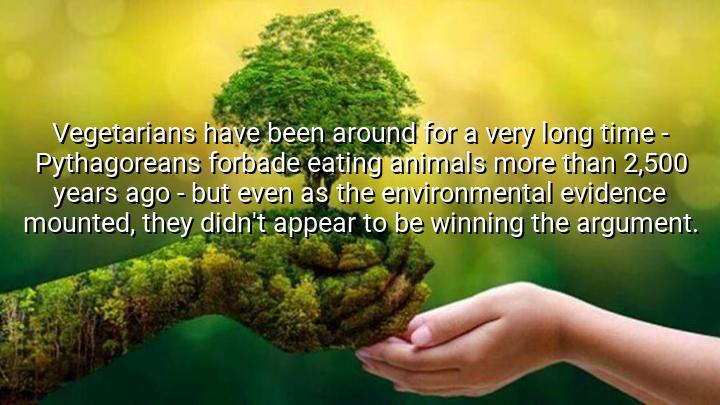




In this quote, Tristram Stuart traces the history of vegetarianism, noting that it is not a modern trend but has roots that go back over 2,500 years. He references the Pythagoreans, an ancient Greek philosophical group, who were among the first to advocate for not eating animals due to ethical and spiritual beliefs. Stuart highlights the long-standing nature of vegetarian principles, yet points out that despite growing environmental evidence supporting the benefits of plant-based diets, vegetarians have historically struggled to gain widespread acceptance and influence in society.
Stuart suggests that even as the scientific community increasingly emphasizes the environmental advantages of vegetarianism, such as its potential to reduce greenhouse gas emissions, deforestation, and resource depletion, the movement has not seen the kind of widespread adoption that one might expect. This might reflect societal resistance to changing dietary habits, cultural attachment to meat consumption, and the dominance of industries that benefit from animal agriculture. His statement underscores the complexity of changing dietary norms despite compelling evidence.
The origin of this quote likely stems from Stuart’s work as a food waste activist and author, particularly in his book "The Bloodless Revolution," where he explores the history and environmental implications of our food choices. Through his research, Stuart delves into the historical context of vegetarianism, showing that its challenges in gaining traction are not just modern, but deeply embedded in societal and cultural practices.
Ultimately, Stuart’s quote draws attention to the longevity of vegetarianism and the resilience of meat-eating cultures, despite the growing body of evidence highlighting the environmental benefits of plant-based diets. It serves as a reminder that changing habits—even in the face of environmental urgency—can be an incredibly slow process, influenced by cultural traditions, economic factors, and social norms.

AAdministratorAdministrator
Welcome, honored guests. Please leave a comment, we will respond soon