

Two prisoners whose cells adjoin communicate with each other by knocking on the wall. The wall is the thing which separates them but is also their means of communication. It is the same with us and God. Every separation is a link.
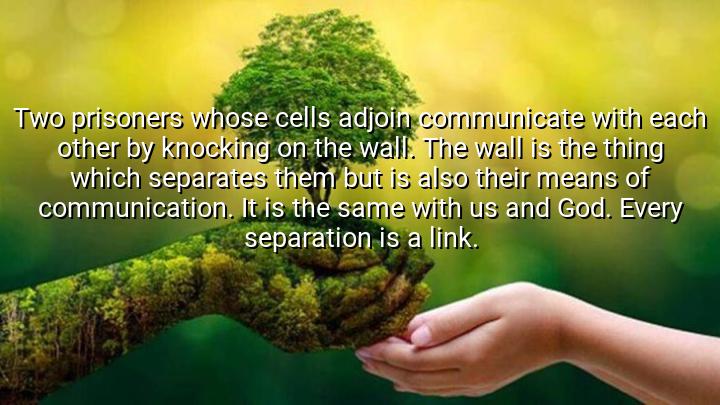




The quote “Two prisoners whose cells adjoin communicate with each other by knocking on the wall. The wall is the thing which separates them but is also their means of communication. It is the same with us and God. Every separation is a link.” by Simone Weil is a profound philosophical and spiritual reflection on the paradoxical nature of distance and connection. Weil, a French mystic, philosopher, and political activist, often explored themes of suffering, divine absence, and spiritual longing, and this quote captures her belief that spiritual separation can itself become a bridge to the divine.
The image of two prisoners communicating through the wall that confines them is a powerful metaphor. The wall, though physically dividing them, becomes the very surface through which relationship is made possible. Similarly, Weil suggests that what seems to separate us from God — our limitations, pain, silence, or doubt — may actually serve as the medium through which we can experience God’s presence. It’s a paradox: distance creates the very conditions for intimacy.
Weil’s statement “Every separation is a link” challenges conventional thinking. She implies that absence, rather than being merely negative or alienating, has its own form of meaningful presence. This idea resonates with her larger theological view that suffering, emptiness, and even despair can become channels for grace, leading one toward deeper understanding and union with the divine.
The origin of this quote is rooted in Weil’s contemplative writings, where she often drew from personal asceticism, deep spiritual inquiry, and her philosophical engagement with Christianity, Platonism, and mysticism. Her use of simple imagery to express complex truths is characteristic of her work, inviting readers to rethink the nature of connection, not in spite of, but through the very boundaries and barriers they experience.

AAdministratorAdministrator
Welcome, honored guests. Please leave a comment, we will respond soon