

Tribalism, after all, is part of our evolutionary DNA. The need to identify with a group, to belong and commune with like-minded people is not only biological, it's what has helped motivate our desire for and devotion to all kinds of important cultural institutions, from organized religion to sports fandom.
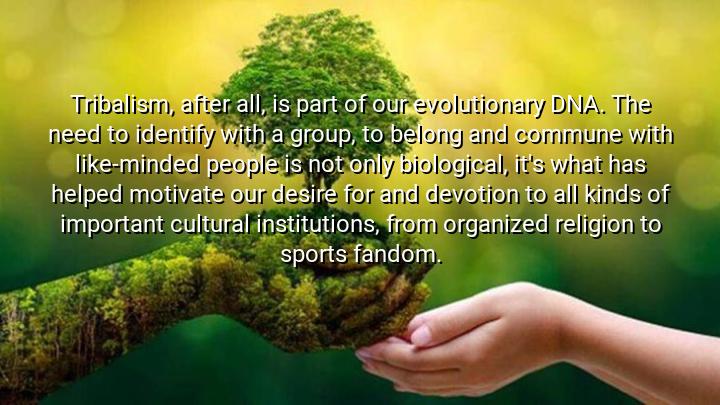




The quote by S.E. Cupp highlights the concept of tribalism as a deeply ingrained part of human nature. According to the passage, our need to belong to a group is not merely a social preference but is embedded in our evolutionary DNA. This suggests that humans have historically relied on community bonds for survival, as being part of a group provided protection, resources, and shared knowledge essential for thriving in early societies. The biological roots of tribalism imply that our inclination to form groups is natural and enduring.
Cupp emphasizes that this desire to identify with like-minded individuals extends beyond mere survival. It influences our participation in various cultural institutions, which serve as extensions of tribal behavior. From organized religion, which offers a structured community bound by shared beliefs, to sports fandom, where people rally around a common identity, these institutions fulfill the human need for connection and loyalty. They act as modern manifestations of the age-old drive to belong to a cohesive group.
The origin of this quote reflects insights from evolutionary psychology and sociology, which study how human behavior is shaped by both biology and culture. Tribalism is seen not just as a social phenomenon but as an evolutionary adaptation that helped humans survive in competitive and often hostile environments. By fostering cooperation within the group and sometimes rivalry with outsiders, tribal behavior enhanced group cohesion and the chances of survival, which in turn reinforced these instincts over generations.
Ultimately, the quote illustrates that while tribalism can sometimes lead to division or conflict, it also serves as a foundation for community, loyalty, and shared identity. Recognizing its biological and cultural significance allows us to understand why humans are naturally drawn to form groups and why these groups often become central to our social lives and cultural engagement. Tribalism, in essence, is both an ancient survival mechanism and a continuing influence on modern society.
If you want, I can also make a more concise version with the keywords bolded for quick reading. Do you want me to do that?

AAdministratorAdministrator
Welcome, honored guests. Please leave a comment, we will respond soon