

Travel, in the younger sort, is a part of education; in the elder, a part of experience.
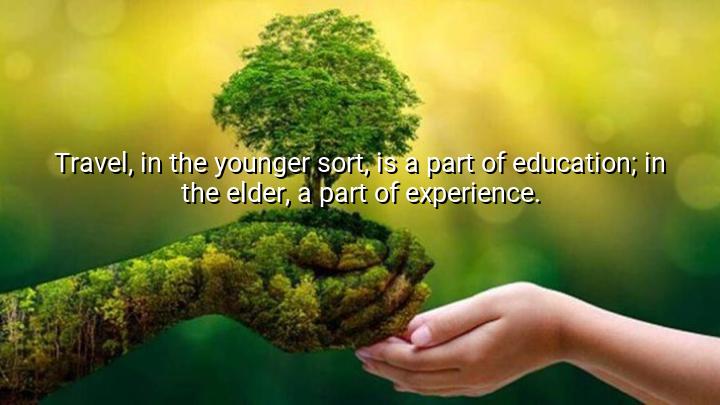




The quote by Francis Bacon, “Travel, in the younger sort, is a part of education; in the elder, a part of experience,” offers a timeless insight into the evolving purpose of travel across the stages of life. For the young, travel serves as a form of education, expanding their worldview, exposing them to new cultures, languages, and ideas. It complements academic learning by offering real-world knowledge and promoting personal growth through exploration and discovery.
In contrast, for the elder, travel becomes a source of experience, reflection, and enrichment. With age comes a broader understanding of life, and travel takes on a deeper, more contemplative role. Rather than learning for the first time, the mature traveler seeks to connect, reflect, and gain wisdom from the diversity of human experience. It becomes a way to savor life and appreciate its richness rather than to simply absorb information.
Francis Bacon, a 17th-century English philosopher and essayist, was known for his writings on knowledge, observation, and human development. This quote appears in his essay “Of Travel,” where he emphasizes the educational value of travel, particularly when undertaken thoughtfully. Bacon believed that exposure to foreign customs, governance, and manners not only broadened one’s mind but also shaped more informed citizens and critical thinkers.
Overall, the quote underscores how the purpose of travel shifts with age. What begins as an essential part of one's education can later evolve into a rich life experience, offering insights not only into the world but also into oneself. Bacon’s perspective remains relevant today, reminding us that travel is a powerful tool for both learning and living.

AAdministratorAdministrator
Welcome, honored guests. Please leave a comment, we will respond soon