

To the European, it is a characteristic of the American culture that, again and again, one is commanded and ordered to 'be happy.' But happiness cannot be pursued; it must ensue. One must have a reason to 'be happy.'
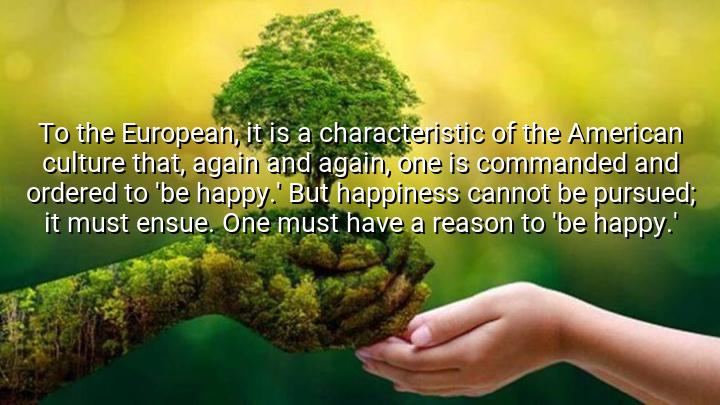




The quote by Viktor E. Frankl — "To the European, it is a characteristic of the American culture that, again and again, one is commanded and ordered to 'be happy.' But happiness cannot be pursued; it must ensue. One must have a reason to 'be happy.'" — reflects Frankl’s critique of the American emphasis on the pursuit of happiness. He contrasts this with European perspectives on happiness, pointing out that American culture often encourages individuals to actively strive for happiness, as though it were a goal to be achieved. However, Frankl argues that happiness is not something that can be directly sought; it is a byproduct of living a meaningful life.
Frankl, a psychiatrist and Holocaust survivor, is known for his development of logotherapy, a psychological approach focused on finding meaning in life. He asserts that happiness is not a goal to chase but something that naturally follows when one is engaged in a purposeful life. In his view, happiness arises as a result of pursuing a meaningful task or connecting with a deeper purpose, rather than being something that can be directly pursued or forced.
The idea that happiness "must ensue" aligns with Frankl’s broader philosophy, which emphasizes the importance of meaning and purpose in life. Rather than focusing on happiness as an immediate or superficial goal, he suggests that fulfillment comes from living a life guided by values, relationships, or work that gives us a reason to be content. For Frankl, happiness is a secondary outcome that emerges when individuals focus on living authentically and meaningfully, not merely on seeking pleasure or avoiding discomfort.
In essence, Frankl’s quote highlights the difference between superficial happiness, which is actively sought after, and deeper, more sustained happiness that naturally arises from a life full of purpose and meaning. He challenges the notion of happiness as something to be acquired, urging instead that it is a product of a life well-lived, rooted in genuine reasons to be content.

AAdministratorAdministrator
Welcome, honored guests. Please leave a comment, we will respond soon